The first time Lily mentioned it, I dismissed it as the harmless imagination of a small child. We were caught in slow evening traffic, the radio playing quietly as we followed our usual route home from daycare. Then her tiny voice drifted from the back seat, breaking the dull routine with a question that felt far too heavy for someone her age.
“Daddy, can we invite my real dad to dinner on Father’s Day?”
My hands tightened around the steering wheel. I forced out a laugh that sounded unnatural even to me and asked what she meant, trying to keep my voice steady. Lily was only five—pure joy with swinging legs and a carefree smile—completely unaware that her words had just shaken my world.
With the simple honesty only children have, she explained that sometimes a man came to our house when I was at work. He brought her chocolate. He sat with her mom in the kitchen and sometimes stayed for dinner.
One time, she said quietly but confidently, he told her that he was her “real daddy.”
My ears rang and a chill ran down my back. I tried to convince myself she was confused, that maybe she misunderstood something or heard a joke. But Lily had never been the kind of child who invented stories.
She noticed everything and repeated things exactly as she saw them. “No, Daddy,” she insisted. “He told me.
Mommy knows him.”
That night I couldn’t sleep. I lay awake staring at the ceiling, replaying her words again and again. I wanted to believe it was a misunderstanding, but the details she gave kept crushing that hope.
By morning I realized I couldn’t live with the uncertainty. Later, I knelt beside her and said gently, “What if we invite your real dad to our Father’s Day dinner as a surprise? But we won’t tell Mommy.
It’ll be our little secret.”
Her face lit up with excitement. Seeing her happiness felt like a knife twisting inside my chest. The days before the dinner passed in a strange blur.
I went through the motions—cleaning the house, setting the table with our best dishes, cooking a meal I knew I probably wouldn’t be able to eat. Every minute felt like I was waiting for an inevitable crash. At exactly 6:07 that evening, the doorbell rang.
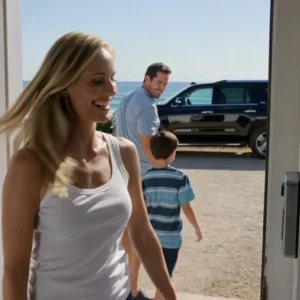
The man on the porch looked about my age. In his hand was a small gift bag, a chocolate bar peeking out from the top. His expression froze when he realized I—not my wife—had opened the door.
Before either of us could speak, Lily rushed past me, calling his name as if she had known him forever. She wrapped her arms around his leg like it was something she had done many times before. Behind me, my wife appeared in the hallway.
The color drained from her face instantly. In that moment, every explanation I had imagined disappeared. Nothing needed to be said.
The truth was written across her expression and in the man’s nervous, shaking hands. I stepped aside and invited him in, my voice strangely calm. I asked Lily to go wash her hands.
As she happily skipped away, humming to herself, the door closed softly behind us—and with it, the life I thought I understood. When we were alone, I asked the only question that mattered: why was he here? He placed the gift bag down and admitted the truth.
Years earlier—before my wife and I were fully committed—they had been together. He had been told Lily was his child, but he chose not to disrupt her life. Instead, he stayed on the sidelines, believing that quietly visiting and remaining in the background was the honorable thing to do.
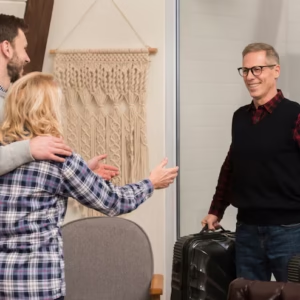
My wife didn’t argue or explain. Her tears said everything. That Father’s Day dinner felt surreal.
Three adults sat around the table, connected by a painful secret, pretending everything was normal for the sake of a child. We laughed at Lily’s stories and passed dishes across the table, protecting her world for one more evening. The real conversation began after Lily was asleep.
There were no angry shouts or slammed doors—only quiet heartbreak. My wife spoke about fear: fear of losing the life we had built, fear that kept her silent for years. The man spoke about regret and longing.
I listened as the identity I had carried for five years slowly came apart. The months afterward were incredibly difficult. There were therapy sessions, legal discussions, and long nights of painful conversations.
I mourned the betrayal and the image of the perfect family I once believed we had. But through that pain, I learned something important: fatherhood is not determined only by biology. It is built through presence—through bedtime stories, scraped knees, early school mornings, and the constant promise to stay.
Those five years of love hadn’t disappeared. They were the very foundation of Lily’s world. In the end, we chose honesty instead of chaos.
Slowly, we rebuilt our family into something different but truthful. Lily would grow up knowing where she came from, but she would never question who her father was. I remained her “Daddy”—the one who stayed every day—while the man with the chocolate found a respectful, limited place in her life.
Healing didn’t happen quickly, and some wounds never fully disappear. They simply change the way you move forward. But the experience made me stronger and more intentional with my love.
Now Father’s Day means something deeper to me. It isn’t about titles or biology. It’s about commitment.
Families aren’t defined by having no secrets. They’re defined by the courage to face the truth together. Our story didn’t unfold the way I once imagined.
But that night on the porch, I made a promise to myself: no matter what the truth brought, I wouldn’t walk away. And I kept that promise.