I thought burying my father would be the hardest part—until I found the key. Hidden in his desk, tied with a faded ribbon, it opened the one door he never let me near. What I found behind it made me question everything I thought I knew about him… and my past.
I sat in the car outside the cemetery, gripping the steering wheel like it might hold me together.
Rain tapped gently on the windshield, soft but steady, like it knew not to be too loud today.
My breath fogged the glass, leaving blurry patches where the outside world disappeared.
I wiped one with my coat sleeve out of habit, though I wasn’t really trying to see anything.
My eyes burned, and my hands trembled in my lap. I felt full of something too heavy to carry. Like a balloon stretched too far, seconds from popping.
Then—tap, tap, tap—on the window beside me.
I jumped a little, heart skipping.
It was Caleb.
He leaned down, his kind eyes meeting mine through the fogged glass.
He opened the door carefully, not saying a word at first. Just breathing with me.
“They’re waiting for you, honey,” he said gently, like the words might break me if they were too loud.
I shook my head. “I can’t.
I just… I can’t go out there. Not yet.”
Caleb didn’t argue. He didn’t rush me.
He just knelt beside me, his jeans soaking up the rain from the gravel.
“You don’t have to say a word,” he said. “Just stand next to me.
I’ll be with you the whole time.”
Tears spilled down my cheeks before I could stop them.
“It feels too real now. Like… if I walk out there, and see the casket, then it’s done.
He’s really gone. And I’m really alone.”
“You’re not alone,” he whispered, reaching for my hand. “I’m right here.
Come on.”
I let him pull me out of the car. My legs felt stiff, like they belonged to someone else. The rain kissed my face as we walked, cold and light.
Each step toward the casket felt like I was sinking deeper into wet cement. I didn’t want to move, but Caleb kept me steady.
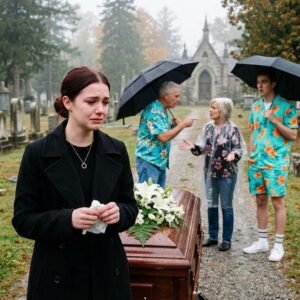
When we reached the grave, the pastor paused and gave me a soft nod. Everyone turned.
I felt their eyes—full of pity, sympathy, but not understanding. None of them knew how much my dad meant to me. None of them knew he was all I had left.
Then I saw it.
The coffin. Dark cherry wood. Shiny.
Too clean. Too still.
That’s when I broke.
I bit my lip, trying not to sob out loud, but the tears came hard.
Caleb pulled me close, his arm around my waist, holding me together when I thought I might fall apart.
Back at the house, the air greeted us like a closed book forgotten on a shelf—dusty, still, and full of silence.
It smelled like old paper, wood polish, and something faintly bitter, like time itself had settled into the walls.
We slipped off our coats in the entryway. The hooks by the door were still the same, though most were empty now.
I hadn’t really been back in years. Not to stay.
Not to look closely. The wallpaper had faded a little more, and the curtains hung like tired arms.
But it was the light that struck me—it felt colder now.
Sharper. Like the house knew something had changed and didn’t know how to comfort me.
I wandered into the living room and stopped in front of the old upright piano. I ran my fingers gently along the keys.
One low note hummed out beneath my touch—soft and sour, slightly out of tune. It echoed in the quiet room like a question no one could answer.
“Kim, come here,” Caleb called from Dad’s study.
I followed his voice, heart already beating faster. He was standing near Dad’s big oak desk, a drawer half open behind him.
In his hand was a small, rusty key hanging from a faded blue ribbon.
“Any idea what this opens?” he asked.
I stared at it. My heart skipped.
“The basement,” I said. “It has to be.”
“The one you were never allowed in?”
I nodded slowly, a strange feeling crawling up my spine.
“Dad always said it wasn’t safe. Old tools, maybe. Or wiring.
I thought it was just junk. Something he didn’t want me messing with.”
Caleb looked at me.
“Should we… check it out?”
My mouth felt dry.
I hesitated, but something inside pulled me forward.
“Yeah,” I whispered. “Let’s see.”
We walked to the narrow door near the kitchen. I used to pass it every day as a girl.
It had always felt like part of the background—unimportant and off-limits.
Now it felt like the center of everything.
I held the key up to the lock, hands trembling just slightly.
Click.
The lock gave way.
The door creaked open, slow and loud. The air that drifted out was cool, earthy, and very still. Like it had been waiting for someone to remember.
The basement smelled like old wood, metal, and something deeper—time, maybe.
The kind of smell that clung to memories.
The single lightbulb swayed gently from the ceiling, casting soft shadows along the walls. Dust danced in the glow like tiny stars, swirling slowly every time we moved.
I stepped down the creaky stairs, each one groaning under my weight.
Caleb followed quietly behind, his hand resting on the railing like it might fall apart if he wasn’t careful.
When we reached the bottom, my eyes adjusted to the gloom. That’s when I saw it.
Against the far wall stood a giant corkboard, wide as the dining room table upstairs.
It was covered in pinned-up photographs, yellowed papers, scribbled notes, and dozens of lines of red thread stretched between them.
It looked like something from a detective movie.
“What is this…?” I whispered, walking toward it like I was afraid it might vanish.
Caleb stayed close behind me. The air felt thick. My fingers trembled as I reached toward the middle of the board.
A black-and-white photo was pinned right at the center.
A woman in a floral dress stood in a garden, smiling gently at someone behind the camera.
Her hair was long and dark, falling in waves around her shoulders. Her eyes—soft and kind—looked like mine.
I dropped to my knees.
“That’s my mom.”
Caleb knelt beside me, his face puzzled.
“I thought your dad said she left.”
“He did,” I said, my voice barely holding steady.
“He said she disappeared when I was four. I always thought that was just a nicer way of saying she ran off.
That she didn’t want to stay. That she didn’t want me.”
We looked closer. Letters folded neatly and stacked by date.
Newspaper clippings circled in red pen.
Old envelopes with faded stamps. Notes in my dad’s familiar handwriting:
“New address in Sioux City?”
Caleb’s voice was soft. “He never gave up.”
I reached up and pulled a sealed envelope from the corner of the board, tucked behind some photos.
It was unopened.
My fingers shook as I broke the seal. I unfolded the letter and read aloud, barely breathing.
“We confirmed it. It’s her.
Here is the correct address…”
I looked at Caleb, my voice catching.
“She’s there.”
He didn’t even blink.
“Let’s go.”
The drive felt longer than two hours. My hands were cold the whole way, twisting and untwisting in my lap.
Caleb kept one hand on the wheel and the other close to mine, resting it on the center console like a quiet promise.
Outside the window, the trees blurred past—early spring maples just starting to bloom.
Their red and green buds looked like tiny sparks waiting to catch fire.
We turned onto a quiet street lined with houses that all looked like they held secrets.
The kind of neighborhood where dogs bark at squirrels and neighbors wave at each other from their porches.
The air smelled like lilacs. Sweet and soft.
I could barely breathe.
As we pulled into the driveway, my heart beat so loud I thought Caleb could hear it. I reached for the door handle but froze. I wasn’t ready.
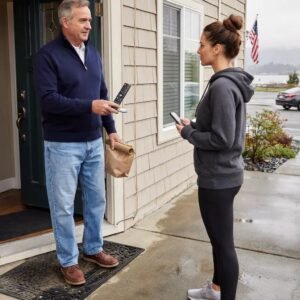
The door opened.
A young woman stood there, maybe nineteen or twenty.
She had her mother’s hair—thick and dark—and eyes that looked too tired for someone that age. Her brow furrowed.
“Hi,” I said, trying to sound steady.
“We’re looking for… Marilyn.
Marilyn Jacobs.”
She blinked, then slowly nodded. “That’s my mom.”
The world tilted slightly under my feet.
“Is she home?” I asked, even though I already knew something was wrong.
She bit her lip, then shook her head. “I’m sorry.
She… she passed away. Just last week.”
I felt Caleb’s hand slip into mine, his fingers squeezing gently.
“Do you know what day?” I asked, barely getting the words out.
The girl—this stranger who looked like someone I might’ve known—paused.
“Tuesday morning.
Why?”
My mouth went dry.
“That’s the same day my dad died.”
She looked at us for a long moment, then stepped aside and opened the door wider. “Please come in.”
The living room was small but cozy.
A quilt lay across the couch, and there was a warm, earthy scent in the air—cinnamon, old wood, something familiar I couldn’t name.
“I’m Ellie,” she said softly, offering a small smile.
“Mom used to talk about her past sometimes. Said she left a family when she was young.
Said it was the biggest mistake of her life.”
“Did she ever say why?” I asked, my throat thick.
“She was scared. She said she wasn’t ready to be a mom. Or a wife.
Life kept moving, and by the time she wanted to fix it… it felt too late. She had me, my brothers. And she was ashamed.”
I couldn’t stop the tears now.
They rolled down my cheeks freely.
“She never stopped thinking about you,” Ellie said. “I’d hear her crying at night sometimes.”
I reached across the coffee table and gently took her hand in mine.
“She never stopped thinking about us,” I whispered. “And my dad never stopped looking.”
Later, we stood in the backyard.
The sun dipped low, casting gold across Ellie’s hair. Birds chirped in the trees. It was so peaceful—too peaceful for everything I felt.
“I guess that makes us family,” I said, trying to smile.
Ellie nodded.
“Yeah. I guess it does.”
We hugged, long and tight, like people trying to make up for years they never shared.
Caleb watched from the porch, his arms crossed, his eyes soft.
“My dad spent his whole life searching,” I said. “He died one step away from the truth.
From this.”
“He got you close,” Ellie said. “Maybe that’s enough.”
“Maybe it is.”
As we drove home later that evening, I looked out the window and thought of Dad.
Of all the time he spent hoping, searching, believing.
And even though he didn’t get to knock on that door himself, I did.
And now I knew.
He was right not to give up.
And somehow, in some quiet, mysterious way…
He brought us together.
Family, at last.
Tell us what you think about this story, and share it with your friends. It might inspire them and brighten their day.