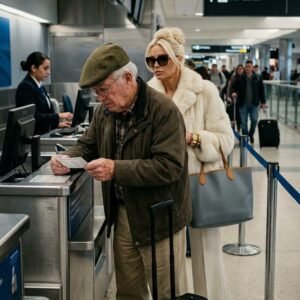
My mother, Evelyn Moore, recently walked into a Mercer and Reed department store and quietly found something she recognized—a midnight blue gown she had made in the fall of 1984. At first, no one believed her. To the staff, she seemed like an elderly woman mistaken about something from long ago.
They guided her away gently, assuming confusion rather than memory. It wasn’t cruelty, but it carried a kind of dismissal that often follows people as they age. Then a young clerk named Leah paused.
Instead of correcting her, she checked. Inside the lining of the dress, stitched carefully and deliberately, was a name: Evelyn Morrow—my mother’s maiden name. And just like that, what had been dismissed as confusion became something harder to ignore.
What Had Been Hidden
My mother explained that she hadn’t made just that one dress. She had been part of a group of women who worked quietly in a small sewing room on the third floor of that same building. They stitched garments by hand—pieces that would later be sold under a polished brand name, far removed from the hands that made them.
They were never publicly named. Their work remained. Their identities did not.
The store’s management, surprised and unsettled, agreed to let us see the old workroom—now abandoned and covered in dust. What Time Had Not Erased
When we reached the third floor, my mother moved without hesitation. She walked to a radiator and reached behind it, into a narrow, hidden space.
From there, she pulled out something wrapped and worn. A burgundy ledger. Inside it were names.
Not just names—but small traces of lives. Women like Ruth Baptiste and Clara Donnelly. Stories written in brief lines, enough to remember, not enough to be known.
These were the people who had built something lasting, without ever being credited for it. An Offer That Missed the Point
The company’s regional director, Daniel Cross, admitted he had never heard of them. The official story had always pointed elsewhere—to a corporate legacy, neatly packaged and presented.
He offered my mother compensation. Recognition. A place at their upcoming relaunch event.
In return, they wanted the ledger. It was presented as appreciation. But it asked for something quiet in return—the kind of quiet that keeps a larger truth from being fully seen.
Choosing What to Carry Forward
My mother did not decide immediately. She spoke with Bernice Hall, one of the few coworkers still living. Together, they understood what was at stake.
This was not only about one person finally being acknowledged. It was about many who never were. So she refused the offer.
Not out of anger—but because accepting it would have narrowed the truth to something smaller than it was. Speaking Without Raising Her Voice
At the evening event, she was introduced as someone to be honored. She stepped forward, not to reject that—but to widen it.
She opened the ledger and began reading. Name after name. She did not accuse.
She did not dramatize. She simply said what had been missing. That these women existed.
That their work remained. That the story being told was incomplete without them. The room shifted.
Not loudly—but clearly. And from the back, where the current employees stood, there was quiet applause that slowly grew. What Followed
The company could not move forward unchanged.
The event they had planned was paused. Conversations began—real ones, slower and less controlled. In the months that followed, my mother worked with a small group to trace those names.
Families were found. Stories were gathered carefully, without embellishment. Not everything could be recovered.
But enough was. The third-floor room was transformed—not into something decorative, but into a space that held memory as it was meant to be held. What Remains
Seeing those names on the wall did something for my mother.
Not pride, exactly. Something quieter. A sense that what had been carried silently for so long no longer needed to remain hidden.
As her own memory has begun to soften with time, that part has stayed steady. Closing
Some histories are not lost because they were unimportant. They are lost because no one insisted on holding them in the light.
My mother did not raise her voice to be heard. She simply refused to let what was true remain unspoken. And in doing so, she returned something to its rightful place—not for herself alone, but for all the hands that had been left out of the story.