His breathing was shallow, and his hands trembled beneath the blanket, but his eyes were steady in a way I hadn’t seen in years. Slowly, he reached under his pillow and pulled out an old savings passbook tucked inside a yellowed envelope. The blue cover was cracked, and the bank logo had faded almost completely.
He pressed it into my hand with surprising strength and whispered, “Only you.”
I leaned closer, thinking he might need water or had mistaken me for someone else.
“Grandpa… what is this?”
He swallowed and shook his head slightly. “Don’t give it to your mother. Promise me.”
I promised, mostly because he looked frightened rather than confused.
A minute later a nurse came in, and he closed his eyes and didn’t speak again.
By evening, he was gone.
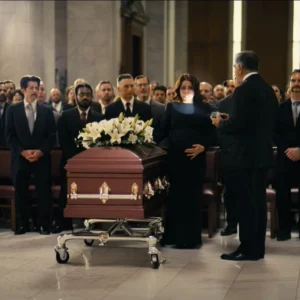
At the funeral, my mother, Linda, wore black sunglasses and carried the kind of expression that warned people not to approach her for long. For years she had treated my grandfather like a burden. She visited only when it looked good to others and later complained about the smell of his apartment, his stubborn habits, and the cost of helping him.
After the burial, she noticed the passbook in my hand and moved toward me quickly.
“What is that?” she asked sharply.
She grabbed it before I could react.
After flipping through the outdated stamps and handwritten balances, she let out a short laugh.
“This thing? It’s ancient. It should’ve been buried with him.”
Then she tossed it into a trash bin beside a folding table covered with paper cups and half-eaten sandwiches.
She turned away immediately, already answering a phone call, already finished thinking about him.
I stood there frozen, anger rising in my chest.
Ten minutes later, when most people had left for the reception, I returned.
I lifted the trash bag and dug through coffee grounds and wet napkins until I found the passbook at the bottom, smeared with frosting from a piece of unfinished cake.
The next morning I skipped work and drove downtown to First Commonwealth Savings, the same bank my grandfather had used for decades. The passbook still smelled faintly like sugar and funeral flowers. I nearly turned around twice before finally stepping through the revolving door.
The branch manager, a gray-haired man named Daniel Mercer, examined the passbook through rimless glasses.
At first he seemed mildly curious.
Then he turned to the middle pages.
The color drained from his face.
He stood so quickly his chair rolled backward.
“Security,” he murmured.
Then, louder, while reaching for the phone, he said, “Call the police.
Don’t let her leave.”
Every person in the lobby turned to look at me.
For a terrifying moment, I wondered if my mother had been right. Maybe the passbook contained something stolen. Maybe my grandfather had hidden money that didn’t belong to him, and now I was standing in a bank holding proof.
“I didn’t do anything,” I said, stepping away from the desk.
“My grandfather gave this to me before he died.”
Mr. Mercer raised a hand—not toward me, but toward the security guards.
“Please stay calm,” he said. “No one is accusing you of anything.”
That didn’t make me feel better.
One guard quietly moved toward the entrance while the other stayed nearby, watching the room carefully.
My stomach tightened.
“Yes.”
His expression grew serious.
“Then you’re exactly where you need to be.”
He asked me to come into his office. I hesitated, but something in his face had changed. He no longer looked worried about me—he looked worried for me.
Inside his office he closed the door and locked it.
Through the glass walls I could still see the lobby and one of the tellers whispering on the phone.
Mr. Mercer placed the passbook between us and opened a secure file on his computer. He asked for my grandfather’s full name, birth date, and the day he died.
I answered each question while he typed quickly.
Then he turned the monitor toward me.
The account was real.
The passbook hadn’t been active in years, but it was linked to a trust created decades earlier. My grandfather had sold farmland outside Columbus in the early 1990s—land that later became part of a large commercial development. The money had been placed into a restricted trust that could not be released until after his death.
With years of interest, reinvestments, and a later legal settlement related to mineral rights, the amount had grown far beyond what I expected.
Just over 2.8 million dollars.
I stared at the screen, convinced I had misread the numbers.
“There has to be a mistake.”
“There isn’t,” Mr.
Mercer said. “But there is a serious problem.”
He opened another file showing months of notes, correspondence, and identification requests.
For six months someone had repeatedly tried to access the trust before my grandfather’s death.
Every request had been denied.
The person making those requests was my mother.
“She claimed your grandfather was no longer capable of managing his finances,” Mr. Mercer explained.
“She said she had verbal authority. When we refused, she became… persistent.”
A chill spread through me.
“She knew?” I asked.
Mr. Mercer nodded.
“She knew enough to try.”
“Your grandfather arranged everything so she could never touch the money.
And according to the trust terms, if someone challenges it in bad faith, their share goes to the named beneficiary.”
I looked down at the worn passbook with my grandfather’s careful handwriting.
The most powerful part of his final gift wasn’t the money.
It was the proof.
The next three weeks felt less like grieving and more like surviving a storm.
My mother called twenty-three times the first day after the bank visit. I didn’t answer. Her messages shifted from anger to tears, then to calm attempts to explain things as “family misunderstandings.”
By the weekend she was outside my apartment, pounding on the door and demanding I let her in.
My neighbor, Frank—a retired mail carrier—warned her he would call the police if she didn’t leave.
She left, but not quietly.
Soon lawyers became involved. One represented my mother. Another, recommended by Mr.
Mercer, represented me and the trust.
That was when I learned how carefully my grandfather had prepared everything.
Years earlier, after my grandmother passed away, he had updated the trust with a detailed statement explaining the origin of the money and why he was removing Linda from any control over it. He wrote that she had once borrowed money using his name, pressured him to sell belongings, and treated him “like a vault instead of a father.”
He also added a final condition.
The trust would only be released if I appeared in person with the original passbook.
Only you.
He hadn’t said those words because he loved me more.
He said them because he trusted me.
My mother still challenged the trust in court, claiming my grandfather had been manipulated and that I had influenced him.
But the bank’s records showed every attempt she had made to access the money before his death.
Her own actions undermined her argument.
The judge dismissed the case.
Because the challenge was ruled to be made in bad faith, the clause in the trust took effect. My mother lost any claim she might have had.
I expected to feel victorious.
Instead I felt sadness… then relief… then guilt for feeling relieved.
Money doesn’t fix a family.
It simply reveals the cracks that were already there.
I paid off my student loans. I bought a modest house with a small workshop in the back—because my grandfather had taught me to build things with my hands. I set aside a college fund for my younger cousin and donated part of the money to the hospice that cared for my grandfather during his final weeks.
But some of it made his final act feel like something more than paperwork.
The passbook now sits in a fireproof box, frosting stain and all.
I could throw it away now that I know what it unlocked.
But I never will.
Because it isn’t just a record of money.
It’s proof that one quiet old man understood everything until the very end.
He knew who would reach for it.
He knew who would laugh.
And he knew exactly who would go back to the trash and dig it out.