By the time I turned into my driveway, the sun over the Bay had already dropped behind the row of skinny eucalyptus trees that lined our street. San Francisco had that washed-out, end-of-day light where everything looks honest. My duplex, my postage-stamp yard, the narrow strip of concrete I called a driveway.
The spot where my car should have been.
The space was empty. No pearl white SUV.
No sleek curved roofline. Just a dark smear of oil where the tires usually rested and a faint outline on the concrete like a chalk body at a crime scene.
For a second my brain refused to cooperate.
I had just finished another eighty-hour week at the data center, stumbling home on autopilot with a backpack full of laptops and laundry. My hands still smelled like cheap office coffee and server-room dust. The numbers in my life always balanced.
Assets mapped to owners.
Keys mapped to locks. Nothing simply disappeared.
But the one thing in my life I had paid for entirely on my own, the one thing that didn’t have my father’s fingerprints all over it—a one-hundred-and-ten-thousand-dollar electric SUV—was gone. My heart didn’t race.
My throat didn’t close.
What I felt instead was a cold, precise click, like a line of code compiling. I pulled my phone from my pocket and hit the first number my thumb knew by muscle memory. My father answered on the second ring, his voice thick with that familiar mix of arrogance and Marlboro smoke.
“Gracie.
You finally off work? I was just about to call you.”
I didn’t bother with hello.
“Where is my car, Dad?”
There was a pause. Not the stunned silence of someone hearing bad news.
The guilty hesitation of a man deciding how much of the lie to serve first.
Then he laughed. Actually laughed. A short, dismissive bark like I’d just asked if he’d borrowed my stapler.
“Relax,” Douglas Rossi said.
“You act like it’s gone forever. Tyler needed it.
Family helps family.”
The words slid through the speaker and lodged under my ribs. I pictured my younger brother behind that wheel—Tyler, who’d racked up more traffic citations than job applications, who’d had his license suspended after his last “little misunderstanding” involving a stop sign and a parked BMW.
I swallowed once.
“Does he still have that suspended license,” I asked, keeping my tone flat, “or did you decide that part didn’t count because it’s family?”
He exhaled, an irritated rush of air. “That’s exactly the attitude I’m talking about. You’ve changed, Grace.
All this tech money has gone to your head.
It’s just a car. You live alone.
Tyler has a fiancée now, image to maintain. You don’t need a one-hundred-and-ten-thousand-dollar status symbol to drive groceries home.”
There it was.
The conversion rate where my effort turned into his entitlement.
Once upon a time, that speech would’ve sent me into a spiral of apology and self-doubt. Was I selfish? Was I ungrateful?
Was I forgetting how much my parents had “sacrificed” to give us a life in this city?
Tonight, the words skimmed across the surface of something much harder. “Where is he?” I asked instead.
“On 101 heading south,” my father said. “He’s taking the car down to Palo Alto to show Megan’s parents you’re not the only success in this family.
They’ve already seen your car parked in front of your little duplex, you know.
People talk.” He chuckled like this was a clever joke. “And don’t start, Grace. I used the emergency key you gave us.
We’re family.
That car belongs to all of us in a way.”
“Thank you,” I said. He sounded pleased.
“See? I knew you’d come around.
That’s my girl.
We’ll talk about how to structure the insurance later so it looks cleaner on paper, but—”
“I wasn’t agreeing,” I cut in. “I was thanking you for confirming it was taken without my permission.”
Before he could process that sentence, I ended the call. My thumb moved faster than my heartbeat.
I opened the manufacturer’s app, the one I’d used every day for the past two years to schedule charges, preheat the cabin, check range before a long drive to the data center.
Tonight, the app felt heavier in my hand. Not like a convenience.
Like a weapon. The map loaded, and a pulsing blue icon appeared on the screen.
My SUV, my one-hundred-and-ten-thousand-dollar asset, was three miles away, moving forty-five miles per hour toward the freeway.
In my world, when a primary asset goes missing, you don’t cry. You troubleshoot. I scrolled to the bottom of the screen and tapped the option the sales rep had mentioned once like a fun party trick I would never need: STOLEN VEHICLE MODE.
A warning popped up.
Enabling this setting will remotely limit vehicle operation and transmit coordinates to emergency services. I pressed confirm.
Somewhere out on Highway 101, a car I had bought with five years of eighty-hour workweeks shifted from comfort mode to compliance mode. The steering would lock at the next complete stop.
The accelerator would become a suggestion instead of a command.
The ignition would not respond to any key that didn’t belong to me. For the first time in my life, I had a system that listened to my boundaries without arguing. Then I dialed 911.
The dispatcher answered with the calm cadence of someone who’d heard every version of panic.
“San Francisco 911, this line is recorded. What’s your emergency?”
“This is Grace Rossi,” I said, my voice steady.
“I’d like to report a vehicle theft in progress.”
I did not say my brother’s name. I did not mention my father or the emergency key or the decades of emotional blackmail tied up in that word family.
“Tell me what happened,” she said.
“A pearl white electric SUV valued at approximately one hundred and ten thousand dollars has been removed from my private driveway without my consent,” I replied. “I have remote tracking and control. I’ve already activated stolen mode.
I can provide live GPS coordinates.”
There was a brief silence as she typed.
“Is the person who took it someone you know?” she asked. This was the fulcrum.
I’d seen enough internet forums to know how this went. Say ex, say sibling, say parent, and suddenly the crime becomes a “dispute,” a civil matter to be sorted out in therapy or, more realistically, not at all.
“Unknown,” I said.
“I was at work. I came home. The vehicle was gone.
I have evidence of unauthorized access.
I’d like this treated as felony theft.”
Her tone shifted almost imperceptibly. The box on her screen flipped from gray to red.
“Understood. Go ahead with those coordinates.”
I read off the latitude and longitude from the app.
She repeated them, then told me officers were being dispatched and that they’d be in touch once the vehicle was secured.
When I ended that call, the silence around me felt different. Not the heavy, suffocating quiet of swallowing my anger for the sake of family peace. This was clean.
Sterile.
The hum of a system finally doing what it was designed to do. I stood in my empty driveway for another beat, staring at the oil stain the way a coroner looks at a toe tag.
Then I turned and walked into my house. Inside, my one-bedroom place still smelled faintly of the chai I’d spilled on the rug last week and the eucalyptus candle I forgot to blow out most nights.
The living room bled straight into a tiny kitchen and, off to the side, a narrow door that led into my home office—the room my father always called my cave.
I shut that door behind me and flipped on the lamp. My desk was a simple slab of reclaimed wood pushed against the window, two monitors, one laptop, a mug with the Turning Tables Data logo printed in chipped navy blue. I sat down, opened my personal laptop, and woke up my spreadsheet.
I wasn’t waiting for the police to call me back.
I was auditing my life. For thirty-one years, I had been the utility player in the Rossi family.
The one who could slide into any position they needed—chauffeur, tech support, emergency loan officer, therapist—while Tyler got cast as the star. In sports, the utility player never gets the trophy.
They don’t get interviews or highlight reels.
You only notice them when they stop showing up and everything falls apart. I scrolled through my online banking tabs, one by one. Every transfer to my parents “just until the insurance check comes through.” Every Zelle payment to cover Tyler’s rent “until his commission hits.” Every Venmo with a fire emoji or a heart because God forbid I make anyone feel like a burden.
Five years of transactions glowed back at me.
Five years of me being the emergency savings account disguised as a daughter. The pattern was so obvious now I wanted to laugh.
Or scream. Or both.
But the part of me that used to break down had been slowly replaced by something tougher every time Douglas told me I was overreacting.
Every time my mother said, “That’s just how men like your father are.” Every time Tyler smirked and called me dramatic for asking when he planned to pay me back. Silence had been the tax I paid to keep the peace. Tonight, the tax code changed.
My phone buzzed on the desk, skittering across the wood.
The screen flashed the word DAD in capital letters I’d been too busy to change. I let it ring twice, then answered, not bothering to put it on speaker.
“Grace,” he barked. No hello this time.
“What did you do to the car?”
“Good evening to you too.”
“Don’t play games with me,” he snapped.
“Tyler was in the middle of an intersection and the whole damn thing turned into a brick. The steering locked. Lights flashing everywhere.
He could’ve been killed.
You get on that app of yours and unlock it right now.”
I pictured my SUV sitting dead center in some exit lane, hazard lights pulsing, Tyler pounding on the steering wheel and cursing the universe for daring to hold him accountable for anything. “It’s programmed to immobilize when reported stolen,” I said.
“I didn’t brick the vehicle. The system did.”
“The system,” he repeated, like the word tasted bad.
“Since when do you care more about some Silicon Valley toy than your own brother?
I told you that car belongs to the family now. I gave it to Tyler. As his father, I decided.
That’s how this works.”
“That is not how titles work,” I replied.
“Or the law. Or basic ethics.”
He scoffed.
“There you go again. Ms.
Data Scientist, lecturing me.
You wouldn’t have half of what you have if it weren’t for me and your mother. Who do you think paid for all those AP classes? Who co-signed those first credit cards?”
I pushed my chair back an inch, grounding my feet on the rug.
“Dad, you keep bringing up investments,” I said quietly.
“Investors expect a return. All I’ve seen is you funneling my returns into Tyler’s losses.”
His anger crackled through the line.
“Watch your tone. You’re a single woman sitting in a rental with more car than you need because you like the way it looks when you pull into the office parking lot.
Your brother is about to marry into a good family.
Appearances matter. He can’t show up in a beat-up sedan his girlfriend’s parents bought him in college. He needs something that tells people the Rossis are winners.”
“That car tells people one thing,” I said.
“That I worked for five years to buy myself something that was mine.”
“You’re being selfish,” he said.
“If you don’t unlock that SUV and call off the police, you are done. Do you hear me?
You are not welcome here. Don’t come to the house.
Don’t call your mother crying.
As of tonight, you’re no longer my daughter.”
There it was. The nuclear option he’d detonated so often over the years that the blast radius no longer scared me. Be obedient or be erased.
Once, that threat had kept me small.
Now it sounded like freedom. I let the silence stretch until I heard his breathing slow just slightly on the other end.
“Douglas,” I said, using his first name for the first time in my life, “if you’re worried about Tyler’s future, you might want to Google the phrase grand theft auto. That’s the conversation the police will be having with him next.”
He sputtered.
“You wouldn’t dare.”
“I already did,” I said, and hung up.
My hand shook after I set the phone down, but not from fear. From adrenaline. I turned back to my laptop.
On another tab sat the folder I’d been building without admitting it to myself: tax returns where I’d claimed my parents as dependents for two years because they “forgot” to file, credit card statements where I’d quietly paid off late fees on accounts my mother swore she had under control, the PDF of a $5,000 transfer labeled “startup buy-in” that I knew had gone straight to an online poker site.
I plugged in my external drive and started dragging files over. If I was going to finally stop being a resource silo for the Rossi family, I needed my own copy of the infrastructure.
By the time dawn pushed a gray line over the edge of the Bay, my archive was complete. I didn’t sleep.
Instead, I showered, pulled on a dark blazer over a T-shirt, and drove my ten-year-old backup sedan—the one nobody in the family ever asked to borrow—to a glass-and-steel tower downtown.
Sarah Cohen’s office sat on the twenty-fifth floor, with a view of the Ferry Building and the Oakland cranes beyond it, frozen like a herd of metal giraffes. Sarah had been my roommate freshman year at Berkeley. Back then, we’d split instant ramen and dreamed about not having to check our bank balances before buying coffee.
She went to law school.
I went into data science. I became the one people called when their systems glitched.
She became the one they called when their lives did. She opened her door before I could knock, barefoot in a navy suit, dark curls piled in a messy bun, legal pads scattered across her desk.
“Grace,” she said, eyes flicking to the external drive in my hand.
“Please tell me you aren’t here because you finally murdered someone at work.”
“Not yet.” I stepped inside and shut the door. “I need a forensic audit. On my family.”
Her face sobered in an instant.
She gestured to the chair.
“Sit. Start from the beginning.”
I didn’t start with my childhood.
I started with the driveway. With the oil stain.
With the empty space.
With my father’s laugh in my ear and that single sentence—family helps family—echoing like a threat. Sarah’s fingers flew across her keyboard as I talked. When I described the remote lock, she nodded once and said, “Smart.” When I told her I’d reported the theft as anonymous, not domestic, her mouth curved just slightly.
“And this,” I said, sliding the drive onto her desk, “is everything I’ve paid for in the past decade that says ‘just till we get back on our feet.’ Transfers, credit cards, insurance premiums, you name it.
I want to know where the money went. All of it.”
“You’re sure?” she asked.
“You know once I open this box, I’m not going to be able to unsee anything.”
“I’m sure,” I said. “Consider it a system audit.
I’ve been the only one keeping the server running.
I’d like to know who’s been overheating the CPU.”
She snorted softly. “You really are a nerd.”
Then she plugged in the drive. While the police followed the GPS coordinates from my stolen-vehicle report, Sarah and I followed the trail of my own bank statements.
It didn’t take long for the pattern to jump out.
“Here,” she said, spinning her monitor in my direction. On the screen was a public record from the San Francisco County Superior Court.
State Farm Insurance v. Douglas and Patricia Rossi.
Date filed: four weeks ago.
Amount: twenty-five thousand dollars. “What am I looking at?” I asked, even though my gut already knew. “Subrogation claim,” she said.
“Looks like your brother caused a pretty nasty accident three months ago while driving your parents’ car.
He’s listed as the driver on the police report. Unlicensed.
At fault. Insurance company denied the claim, paid out the other party, and now they’re coming after your parents for reimbursement.”
Twenty-five thousand dollars.
A number that would barely dent my savings now, but to my parents—sitting in their waterfront house mortgaged to the hilt—that figure might as well have been a million.
I sat back, the cheap leather chair creaking under the shift of my weight. “So they were drowning,” I said. “And instead of selling the boat they bought to impress the yacht club, they tried to grab my life raft.”
Sarah’s eyes met mine.
“They didn’t gift your car to Tyler because they love him more,” she said.
“They stole your one-hundred-and-ten-thousand-dollar asset because their own is likely totaled or seized, and they needed something clean in the family to hide behind. If the accident victim’s attorneys expand the search for assets, they’ll see your car on paper as yours alone.
They figure if it ‘belongs’ to Tyler, they can argue it’s separate.”
I let that sink in. My father’s family-first speeches, his lectures about loyalty and legacy—they were nothing but a sales pitch for his own insolvency.
“How much of this do you think he planned?” I asked quietly.
“As opposed to improvising the fraud?” Sarah shrugged. “Let’s find out.”
She clicked into another set of logs—this time, from my own home office. “Grace,” she said slowly.
“When’s the last time you checked your workstation’s access history?”
I frowned.
“Last month, maybe? I’ve been slammed.
Why?”
She rotated the screen again. There it was in black and white: a login to my desktop at 2:17 p.m.
on Tuesday.
My user credentials. My IP address. The problem was, at 2:17 p.m.
on Tuesday, I’d been in a server room in Daly City, wearing a hard hat and arguing with a network engineer about airflow.
My stomach dropped. “I have remote access set up,” I said slowly.
“But it’s behind a VPN. And two-factor.”
Sarah shook her head.
“This wasn’t remote.
These logs are local. Somebody sat in your chair and used your machine.”
My mind snapped to the emergency key on the hook in my parents’ kitchen. The one I’d handed to my father the night they moved into the waterfront house, pressed into his palm like a peace offering.
“For emergencies only,” I’d said, wanting so badly to be considered responsible.
Trustworthy. A good daughter.
He’d kissed my forehead and called me his rock. Apparently, attempted grand theft counted as an emergency.
Sarah pulled up another window.
“Your workstation was used to access the state’s digital title portal,” she said. “Repeatedly. Someone uploaded a PDF to the system and attempted to initiate a title transfer on your vehicle.”
The room seemed to tilt for a second.
“Let me guess,” I said.
“From my name to Tyler’s.”
She nodded once. “And the PDF?”
“A scanned bill of sale,” she said.
“Purportedly signed by you. Only the signature doesn’t match the one on your license.
And the metadata on the scan?
It’s from a multifunction printer registered to your parents’ address. They copied your old signature from some prior document and pasted it into a fake sale.”
I stared at the screen. At the ugly digital footprint of a man who had always talked about honor and loyalty and how the Rossis weren’t like other families.
My father hadn’t just borrowed my car.
He had broken into my home, sat at my desk, used my own computer against me, and tried to erase my legal ownership moving forward. This wasn’t messy love.
This was fraud. Sarah leaned back, the wheels of her chair rolling a few inches.
“Grace, this is more than enough for the DA,” she said.
“We’re talking attempted identity theft, attempted fraudulent title transfer, and a theft of a one-hundred-and-ten-thousand-dollar vehicle. Combined with the 911 call and the immobilization logs, this is open-and-shut. Are you sure you want to go all the way?”
I thought of my mother’s voice when she wanted something—soft and pleading, every sentence ending with we’re family.
I thought of Tyler’s smirk when he’d show off his latest watch, each one bought with money that never seemed to come from his own account.
I thought of my father’s threat the night before: You’re no longer my daughter. “I think,” I said slowly, “they made that choice for me when they tried to rewrite the part where I exist.”
Sarah nodded once and turned back to her keyboard.
“Then let’s give the DA something they can’t ignore.”
We assembled the packet together—screenshots of my app showing the activation of stolen mode, the GPS coordinates time-stamped with my 911 call, the workstation logs proving unauthorized physical access to my home office, the attempted title transfer with my forged signature and my parents’ printer in the metadata. Every line of text, every time stamp, every IP address was a tiny rebellion against a lifetime of being told my reality was overblown.
When Sarah finally hit send on the secure portal to the district attorney’s office, I felt something unclench in my chest that I hadn’t realized I’d been holding since I was thirteen years old.
I wasn’t tattling. I was documenting. —
Two days later, my mother called.
She didn’t start with hello either.
“Gracie, we need to talk,” she said, her voice trembling. “Your father is beside himself.
Tyler is humiliated. Megan’s parents are asking questions.
What were you thinking, involving the police?
This is family business.”
I was standing in my tiny kitchen, watching the fog roll in over the Bay through the window above the sink. My backup sedan keys sat on the counter beside my mug. The hook where my emergency house key used to hang was empty.
“Mom,” I said, “someone broke into my home, forged my signature, and stole a one-hundred-and-ten-thousand-dollar vehicle I paid for alone.
That’s not family business. That’s a crime.”
“You always make things sound so dramatic,” she murmured.
“Your father only did what he thought was best. Tyler had that awful accident, you know that.
The insurance company is trying to ruin us.
We could lose the house. Your father’s blood pressure—”
“He had a choice,” I said. “Sell the boat.
Sell his watch collection.
Downsize the house he can’t afford. Or steal from his daughter.”
“You don’t understand,” she said, slipping into that familiar whine.
“This is your brother. He’s always struggled.
He just needs a little help getting on his feet so he can marry Megan and start a family.
Her parents are very particular. They expect a certain level of…stability.”
“Stability,” I repeated. “Like not driving unlicensed and causing accidents?”
She gasped softly.
“That’s not fair.
He made a mistake.”
“Then he can face the consequences,” I said. “Just like any other adult.”
Her voice hardened.
“If you keep pushing this, don’t expect us to be there when you finally realize you need your family.”
I thought of every time I’d shown up with groceries when their fridge was empty because Dad’s consulting check was late. Every time I’d paid the property tax bill to keep the San Francisco waterfront dream alive.
Every time I’d fixed their Wi-Fi, their phones, their online banking, the very systems they’d used to rob me.
“I needed my family a long time ago,” I said. “You were busy bailing Tyler out of his latest mess.”
She sniffed. “You know your father will never forgive you for this.”
“He doesn’t have to,” I replied.
“A judge will be fine.”
I ended the call gently, set my phone down beside the keys, and exhaled.
The next day, an email from Sarah popped up in my inbox with no subject line, just a single line in the body. Tonight.
Six p.m. Waterfront house.
Wear something you can walk away in.
Officer Martinez will already have the warrant. My parents’ house sat on a narrow sliver of San Francisco waterfront real estate, all glass and angles and white stone that looked best from a distance. Up close, you could see the hairline cracks in the stucco, the salt stains on the metal railings, the tiny FOR SALE BY OWNER sign that had come and gone from the lawn twice in the last year.
When I pulled up at six on the dot, an unfamiliar luxury sedan was already parked out front.
Megan’s parents, I guessed. They had the kind of money that came with generational ease, not eighty-hour weeks.
I climbed the front steps with my folder tucked under my arm, the emergency key absent from my key ring for the first time in seven years. My mother opened the door before I could knock.
Her pearls were on, which meant she was bracing for battle.
“Gracie,” she said, pulling me into a hug that was more grip than embrace. “Thank God you came. We can still fix this.”
I stepped back.
“We’re not here to fix anything,” I said.
“We’re here to clarify.”
The living room was staged like a courtroom. My father sat in his favorite wingback chair near the window facing the Bay, framed exactly how he liked to be—city lights behind him, leather under him, crystal tumbler of something expensive in his hand.
Tyler lounged on the edge of the sofa, jaw tight, eyes glued to his phone. Next to him sat Megan, perfect blowout, perfect nails, perfect posture, her parents opposite them on the other couch.
Every eye turned to me when I walked in.
“Sit down,” Douglas said, in the tone he used on junior associates and waiters who brought him the wrong drink. I stayed standing. “We called this meeting,” he began, “because your behavior has put this family in an impossible position.
The police, Grace?
Really? Over a car?
Over a misunderstanding?”
“A misunderstanding,” I repeated. “Yes,” he said.
“You gave us an emergency key.
Tyler needed the vehicle. We are your parents. We make decisions for the good of the family.
That’s how this works.
Instead, you went running to strangers who don’t understand our dynamic. You have no idea what kind of trouble you’ve brought to our door.”
He lifted his glass and took a long swallow, as if he were the one who needed strength.
“Actually,” I said, “I know exactly what kind.”
I reached into my bag and pulled out the set of bound documents Sarah had prepared—five identical packets, each one labeled with a neat, simple title: ROSSI FAMILY FINANCIAL SUMMARY. One went on the coffee table in front of Douglas.
One in front of my mother.
One in front of Tyler. One—carefully, almost gently—in front of Megan. And the last one stayed in my hand.
“This isn’t a discussion,” I said, my voice as level as if I were presenting quarterly results.
“Think of it as a closing statement.”
Douglas frowned, flipping open the first page. “What is this supposed to be?”
“Evidence,” I said.
The first section was simple: a timeline of transfers from my accounts to theirs. Every “loan” to cover Tyler’s latest emergency.
Every mortgage payment I’d floated when the waterfront dream started sinking.
Every credit card I’d paid off under the heading Just Until. My mother’s hands shook as she read, pearls clicking softly when she swallowed. “You didn’t have to document this,” she whispered.
“We’re family.”
“That’s why I did,” I replied.
The second section covered Tyler’s greatest hits. The five-thousand-dollar “ground floor investment” wired into an online poker account.
The string of overdrafts on the joint card my parents had foolishly given him. The police report from three months ago describing an unlicensed driver named Tyler Rossi blowing through a red light and totaling my parents’ sedan.
Megan’s color drained slowly as she scanned the page.
“Tyler?” she said, her voice small. “You told me that accident wasn’t your fault. You said it was just a fender-bender.”
He shifted in his seat.
“Babe, this is all blown out of proportion,” he muttered.
“Grace is making it sound worse than it is. Insurance always exaggerates.”
“The insurance company didn’t exaggerate the twenty-five-thousand-dollar judgment,” I said.
“Or your suspended license.”
Megan’s father leaned forward, reading. “You’ve been driving my daughter around the city with no license?” he asked quietly.
Tyler’s mouth opened and shut.
No one rushed to fill the silence for him. The third section was the one that made my father’s face change. Sarah had laid it out like a story: screenshots of my workstation access logs showing a Tuesday afternoon login while I was miles away; the IP address and device ID matching the router and printer at this very waterfront address; the transaction history from the state’s digital title portal showing an attempted transfer of a one-hundred-and-ten-thousand-dollar SUV from my name to Tyler’s using a forged bill of sale.
“Identity theft,” Megan’s mother said quietly, reading the header Sarah had added.
“Attempted fraudulent transfer of property.”
I watched Megan’s eyes as she took in the words. “Is that true?” she whispered to Tyler.
“Did your parents really try to steal your sister’s car and put it in your name?”
“It’s not stealing,” my father snapped, finally losing his calm. “It’s managing resources.
Grace bought a car she didn’t need.
Tyler needed it. I made an executive decision. That’s what heads of families do.”
“No,” I said.
“That’s what embezzlers do.”
His gaze snapped to me, sharp as glass.
“You ungrateful girl. After everything we’ve done for you—”
“You mean after everything I’ve paid for?” I asked.
Megan closed the packet with slow, deliberate care and placed it on the table. “I can’t do this,” she said, standing up.
Her voice was steady, but her hands trembled as she grabbed her purse.
“I’m not marrying into a family that treats fraud like a strategy.”
Tyler lurched to his feet. “Megan, wait,” he pleaded. “It’s not what it looks like.
My sister is just bitter.
She’s always been jealous, she—”
She looked at him like she’d never seen him before. “Your sister bought a one-hundred-and-ten-thousand-dollar car with her own money,” she said.
“You tried to steal it. There’s nothing to be jealous of.”
Megan’s parents stood with her.
They didn’t look at my father or my mother as they walked out.
The front door closed with a soft, decisive click. For a beat, the only sound in the room was the faint clink of ice in my father’s glass. Then blue and red light washed over the white walls as a patrol car pulled up outside.
Officer Martinez didn’t bother with theatrics.
He knocked once, firm and professional. My mother jumped.
My father straightened his shoulders as if he could intimidate the law with posture. I stayed where I was, my back to the window, my folder still in hand.
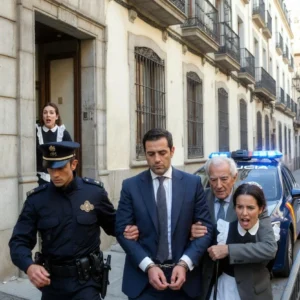
The front door opened again, and two uniformed officers stepped into the foyer.
Martinez’s gaze swept the room in one practiced glance, landing on me for half a second before moving to Tyler. “Tyler Rossi?” he asked. Tyler froze.
“Yeah?”
“Mr.
Rossi, you’re under arrest for grand theft auto and related offenses,” Martinez said, his voice calm. “We have a warrant signed by Judge Harmon.
Please stand up and place your hands behind your back.”
My mother let out a strangled sound. “There has to be some mistake,” she said, rushing forward.
“This is a family misunderstanding.
We’ll sort it out. We don’t need—”
“Ma’am,” the second officer said, holding up a gloved hand, “we’re acting on a warrant based on evidence submitted to the district attorney’s office. If you have questions, you can direct them there.”
Douglas shot to his feet.
“This is outrageous,” he thundered.
“I’ll sue the city. I’ll have your badges.
Grace, tell them this was all a mistake.”
I looked at Tyler as Martinez read him his rights. His face, usually flushed with bluster, had gone chalky.
His eyes kept darting to my father, then to me, like someone would step in and rewrite the ending.
Nobody did. “I already told them everything they needed to know,” I said quietly. The metallic click of the handcuffs closing around Tyler’s wrists sounded louder than any of my father’s threats ever had.
They walked my brother out past the wall of framed family photos—Douglas shaking hands with city officials at charity galas, Tyler in a cap and gown the year he’d barely scraped through community college, me in the background of most of them, half cut off by the frame.
My father watched them go, his chest heaving. Then he turned to me, eyes narrowed to slits.
“You did this,” he said. “You destroyed this family over a car.”
I met his gaze without flinching.
“You destroyed this family when you decided my life was a line item you could move around,” I replied.
He opened his mouth to fire back, but the second officer stepped between us. “Ms. Rossi,” Martinez said, his tone shifting, “we’ll be in touch about retrieving your vehicle from impound.
It’ll be held as evidence for a few days, but we’re expediting the release.
Your cooperation made this a lot cleaner than most cases like it.”
As they left, the house felt strangely hollow. The view of the Bay was the same.
The furniture was the same. But the hierarchy that had ruled this space my entire life had finally cracked.
I set my remaining copy of the packet on the coffee table.
“For what it’s worth,” I said to my parents, “this is the last time I’ll ever have to explain myself to you in this house.”
My mother’s eyes filled with tears. “Gracie, please. You don’t mean that.”
I thought of the emergency key that had once hung on their wall.
The one I’d removed and dropped into a public trash can on my way over.
“I do,” I said. Then I walked out.
Ten days later, I stood in a fluorescent-lit garage that smelled like rubber and stale coffee, staring at my SUV where it sat between two dented sedans in the police impound lot. Up close, it looked the same.
Pearl white paint flawless, tires still sharp with tread, touchscreen asleep behind the tinted glass.
But when I opened the door, the air that drifted out was sour with old cigarette smoke and cheap beer. Tyler’s rage had soaked into the upholstery. I slid into the driver’s seat and wrapped my hands around the steering wheel.
This car had been my freedom, my reward, my proof that the eighty-hour weeks and the sleepless nights had bought me something solid.
Now it smelled like everyone who’d tried to take that from me. I didn’t drive it home.
Instead, I took it straight to a high-end detailing shop in SoMa, the kind of place that catered to tech bros and venture capitalists with more car than parking space. The guy at the desk raised an eyebrow when I told him what I wanted.
“Full decontamination,” I said.
“Every surface. Pull the seats if you have to. I don’t care what it costs.
I want it to smell like it just rolled off the line in Fremont again.”
He whistled softly when he saw the impound paperwork.
“Rough story?”
“Family story,” I corrected. He winced.
“Those are worse.”
While the crew stripped and scrubbed the physical traces of my brother out of my car, Sarah stripped the legal traces of my parents out of my life. The restraining order hearing was almost anticlimactic.
The judge barely looked up from the stack of exhibits Sarah handed over—workstation logs, title portal records, voicemails where my father threatened to erase me—before signing the order granting me protection from Douglas, Patricia, and Tyler for the next five years.
Five years felt both too long and not nearly long enough. Three months after that, the waterfront house went into foreclosure. Uncle Mike called to tell me.
He was the only one in the extended family who didn’t treat money like a game.
“Doug raided what was left of his IRA to pay Tyler’s attorney,” he said. “Didn’t factor in the taxes or the ten-percent penalty.
Now the bank wants their pound of flesh and there’s nothing left to give.”
“Where are they going to live?” I asked. He sighed.
“Your dad says he’ll figure something out.
Your mom’s talking about moving in with her sister in Daly City for a while. None of it’s your responsibility, Grace.”
Once, that sentence would have sounded like a lie. Now it felt like a benediction.
As for Tyler, he ended up exactly where Sarah predicted he would: in county jail for ninety days.
None of the usual cousins or uncles stepped up to post bail this time. Word travels fast in families, especially when it comes with documentation.
My packet had made the rounds. It turned out people were willing to look away from a golden child’s mistakes while they were theoretical.
It was harder to ignore them printed in twelve-point font with bank logos in the corner.
The night Tyler was booked in, I sat alone in my quiet duplex, the eucalyptus candle burning low on the coffee table, my SUV parked in the driveway outside, smelling crisply of leather conditioner and nothing else. For the first time in years, my phone didn’t buzz with some variation of Can you help us out just this once? The silence felt expensive.
It also felt like mine.
I thought about forgiveness, that word my parents had weaponized every time they needed me to swallow something sharp. Forgive, Gracie.
Let it go. Don’t hold grudges.
I wasn’t sure yet what forgiveness would look like in this new version of my life.
What I did know was that it wouldn’t involve handing over passwords, keys, or assets to people who saw me as infrastructure instead of as a person. Maybe forgiveness, for me, started with telling the truth. With saying out loud that my one-hundred-and-ten-thousand-dollar SUV had never really been the most expensive thing on the line.
The real cost had been the years I’d spent believing that my success was a communal resource, that saying no was cruelty, that setting boundaries meant I didn’t love my family enough.
I was done paying that price. If someone like me had stumbled across a story like this five years ago—a woman standing in her driveway staring at an empty space where her hard work used to sit—I think it would have changed things sooner.
Maybe she would have called 911 the first time a boundary was crossed instead of the hundredth. So here it is, for her.
If you’ve ever watched a parent or sibling treat your bank account like their personal emergency fund, if you’ve ever been told that family helps family only when you’re the one doing all the helping, hear me clearly.
You are not a resource silo. You are not infrastructure. You are the architect of your own life, and you are allowed to protect the fortress you built.
No emergency key required.
The strange thing about drawing a hard line is that life doesn’t explode the next day. It just…keeps going.
The Monday after the restraining order hearing, I still rode the crowded Caltrain down to the data center. I still answered tickets about glitchy dashboards and broken queries.
People still microwaved fish in the break room like nothing in the universe had fundamentally shifted.
I was the only one who knew that the ground under my feet wasn’t the same. Two weeks later, I sat on a gray couch in a therapist’s office half a mile from my duplex, fingers curled around a paper cup of water that tasted faintly of plastic. A framed print of the Golden Gate Bridge hung behind her desk, the kind you could buy at any home goods store.
It was meant to be soothing.
“So,” Dr. Patel said, crossing one leg over the other.
“Tell me why you’re here.”
I stared at the condensation sliding down the side of the cup. “My father tried to steal a one-hundred-and-ten-thousand-dollar car from me and put it in my brother’s name,” I said.
“The police arrested my brother.
My parents say I destroyed the family. I keep waiting to feel guilty and I’m…not. I just feel tired.”
A tiny smile tugged at the corner of her mouth.
Not amused—recognition.
“That’s a lot in one sentence,” she said. “Let’s start with the tired.”
For an hour, I talked.
About the emergency key. About the oil stain in the driveway.
About watching Tyler’s fiancée walk out with my audit packet in her hand.
About my mother’s voice saying You’ll regret this one day, you know that. Dr. Patel didn’t interrupt much.
When she did, it was to ask questions that landed like pebbles in still water.
“What did it cost you, growing up, to keep the peace?”
“Who taught you that your value was measured in what you could provide?”
“When you picture that empty driveway now, what do you feel in your body?”
The answers surprised me. Not because I didn’t know them, but because I’d never said them out loud.
Saying it out loud felt like another lock clicking open. On my way home, I drove the SUV along the Embarcadero, the Bay to my left, the setting sun painting the water in streaks of copper and pink.
The car smelled like new leather and citrus cleaner now.
If you didn’t know its history, you would never guess it had spent ten days in impound and four hours as a smoking room for my brother’s panic. At a red light, I rested my forehead against the steering wheel and let myself ask the question I’d been dodging. If they called tomorrow and truly apologized—not the manipulative kind, not the I’m sorry you feel that way version, but a real one—would I want them back in my life?
The answer was a quiet, stubborn no.
Have you ever realized you were holding a door open for people who never intended to walk through it? Work noticed the change before I did.
“Whatever you’re doing, keep doing it,” my manager said one afternoon, leaning against my cubicle wall with a paper cup of cold brew. “You’re actually taking lunch breaks.
That’s…new.”
I glanced at the clock.
It was 12:24 p.m. For the first time in years, my calendar from eleven-thirty to one wasn’t jammed with back-to-back meetings and urgent requests. “Trying something radical,” I said.
“It’s called not being everyone’s emergency contact.”
He laughed, assuming I meant tickets and on-call rotations.
I didn’t correct him. A few weeks later, HR asked me to speak on a panel about financial wellness for employees from “non-traditional family backgrounds.” The phrase made me snort.
There was nothing non-traditional about an oldest daughter quietly funding her family’s lifestyle. There were entire Reddit threads dedicated to it.
But I said yes.
On stage in the company auditorium, under soft lights that made everyone look a little washed out, I told a sanitized version of my story. No names. No specific numbers.
Just the broad strokes: high-earning child, financially dependent parents, golden-child sibling, a pattern of “loans” that never got repaid, and the eventual breaking point.
“What would you tell someone who’s still in it?” the moderator asked. “Still bailing out their brother or paying their parents’ mortgage in secret?”
I looked out at the rows of faces—some bored, some politely interested, some staring at me with a focus that felt almost hungry.
“I’d tell them to treat it like any other investment,” I said. “Track every dollar.
Name it.
Stop telling yourself it’s temporary if it’s been happening for ten years. And ask yourself a very simple question: if this person were a stranger, would you keep giving them money?”
The room went very still. Then I added, more quietly, “And if the answer is no, ask yourself why being related gives them a discount on your boundaries.”
Afterward, in the lobby, a woman about my age in a blue blazer stopped me.
“My mom has my credit card,” she blurted, eyes shiny.
“She says she only uses it for groceries, but I just found out she’s been paying her boyfriend’s rent with it for months. When I confronted her, she called me ungrateful.
I thought I was crazy for being angry.”
“You’re not crazy,” I said. “You’re undercharged.”
She huffed out a laugh that turned into a half-sob.
“What did it take for you to cut them off?” she asked.
I thought of the empty driveway. The forged signature. The way my father had said You’re no longer my daughter like he was taking back a gift.
“It took realizing the cost of not doing it was higher,” I said.
“Staying was killing parts of me I actually needed.”
Her shoulders sagged with something like relief. Have you ever sat across from a stranger and heard your own story in their voice?
Holidays were the hardest. The first Thanksgiving after everything went down, my phone stayed stubbornly silent.
No group text about what time to put the turkey in.
No last-minute call from my mother asking me to bring “just a few sides” and then handing me the entire menu. The restraining order meant they legally couldn’t reach out. They obeyed it, at least on paper.
I half-expected some dramatic gesture—a letter, a third cousin showing up at my door “just to talk”—but if there were backdoor attempts, they didn’t make it to me.
Uncle Mike called instead. “You got plans?” he asked.
“Not really,” I admitted, eyeing the lone pumpkin on my kitchen counter. “I was going to see what kind of Thanksgiving Trader Joe’s can fit into one brown bag.”
He snorted.
“Put on some real pants.
You’re coming to my place in Daly City. We’re doing potluck. My kids want to meet the cousin who sent their uncle to jail.”
“That’s…not exactly how that worked,” I said.
He chuckled.
“I know. They know.
It’s just how stories sound in high school.”
His house was smaller than my parents’ old place, a single-story with peeling paint and a yard crowded with mismatched lawn chairs. Inside, it smelled like garlic and roasting turkey and that canned cranberry sauce that keeps the shape of the can.
Mike’s wife, Lena, pulled me into a hug that smelled like flour and vanilla.
“I’m glad you’re here,” she said simply. At the table, between mouthfuls of mashed potatoes and green bean casserole, their daughters peppered me with questions. “Is it true your brother tried to steal your Tesla?” the younger one asked, eyes wide.
“It’s not a Tesla,” I said.
“Different brand. And he didn’t try.
He succeeded. For a little while.”
The older one, a junior with a nose ring and a clear sense of justice, shook her head.
“My dad said you’re the only one in that branch of the family who remembers how to read paperwork,” she said.
“Can you look at my student loan stuff later?”
I laughed. “Sure,” I said. “But we’re starting with the part where you promise you won’t take advice from anyone who treats debt like a personality trait.”
For the first time in a long time, I went home from a family gathering feeling full instead of emptied out.
The hinge wasn’t the turkey.
It was the absence of a bill at the end. News about my parents and Tyler reached me in fragments.
A Facebook post from a cousin showing my parents’ old waterfront house with a big BANK-OWNED banner across the front. A voicemail from Uncle Mike months later: “They’re in a rental in South San Francisco now.
Two bedrooms.
No view. Your mom’s thinking about picking up shifts at a grocery store. Your dad’s talking about consulting, but no one wants to hire a guy with his Google results.”
Google had not been kind.
The local paper had run a small story about the “family grand theft auto” case.
No names, but the details were specific enough that anyone who knew us could connect the dots. Someone at my parents’ old HOA had clearly spilled, because the comments under the article were brutal.
I didn’t read them all. Just enough to see one line that stuck with me: This is what happens when you treat your kids like retirement plans instead of people.
Tyler got out of county after ninety days.
I didn’t see him, of course. The restraining order made sure of that. But his Instagram shifted—from bottle service photos and poker tables to grainy shots of a warehouse, captioned “New beginnings.”
I found out through Mike that he’d picked up a job at a distribution center in Brisbane, the kind where you clock in before sunrise and leave with your back aching and your hands raw.
“He keeps saying it’s temporary,” Mike said.
“He still thinks the windfall is coming. Lottery ticket, crypto, something.
He doesn’t understand that your father’s well is dry now.”
“That well was never his to drink from in the first place,” I said. There were moments—late at night, when the house was too quiet and the foghorns on the Bay sounded closer than they were—when I wondered if I’d gone too far.
Not often.
Just enough for the thought to sting. What would you have done, standing in that driveway with your savings on four stolen wheels and your father laughing in your ear? One Saturday in early spring, Sarah dragged me to a rooftop bar in the Mission to celebrate another win—a settlement in a totally unrelated case involving a crooked landlord and a very stubborn nurse.
“You know what I love about you now?” she said, shouting over the music as we leaned against the railing.
“You make decisions. Old Grace would still be running spreadsheets, trying to calculate exactly how much of her soul she could give away without going bankrupt.”
“Old Grace still lives in here,” I said, tapping my chest.
“She just has better boundaries now.”
She raised her glass. “To better boundaries.”
We clinked.
“I got an email from your dad’s lawyer last week,” she added casually.
My grip tightened on my drink. “What did he want?”
“Nothing I had to answer,” she said. “Technically, it was just a fishing expedition.
He floated the idea of a ‘family mediation’ to avoid further public embarrassment.
Translation: he wanted to see if you’d agree to drop the restraining order and maybe write a letter to the judge about how this was all a misunderstanding.”
I snorted. “Let me guess.
In exchange for what? A heartfelt apology and a Costco sheet cake?”
She grinned.
“You really are getting good at this.
I told him no. Politely. With citations.”
The relief that washed through me was embarrassingly visible.
She noticed, of course.
“You know you can always say no yourself,” she said. “You don’t need a lawyer to do it for you.”
“I know,” I said.
“But it helps having a witness.”
She squeezed my shoulder. “That’s the thing about boundaries.
They’re yours.
Other people can respect them or not. But you’re the one who has to keep holding the line.”
The city spread out below us—rows of flat roofs, the Bay glinting in the distance, the faint outline of the bridge cutting the horizon. My SUV was parked four blocks away in a paid lot, locked, alarm armed, app on my phone ready to ping if anything nudged it.
For the first time, I realized I could lose the car tomorrow and still be okay.
The real asset I’d reclaimed wasn’t parked on any street. A year to the day after the arrest, I took the SUV on a solo road trip down Highway 1.
No purpose. No family obligation.
No one to visit or rescue.
Just me, the Pacific on my right, and a playlist full of songs I loved but had always turned down so no one would complain. I stopped in Santa Cruz for a boardwalk corn dog and a walk on the pier. In Monterey, I splurged on a hotel room with a balcony overlooking the water and ate room service in a fluffy white robe while answering exactly zero emails.
On the second night, I parked at a turnout just south of Big Sur and watched the sun slam into the ocean in a blaze of orange and pink.
The car’s hood ticked as the engine cooled. The air smelled like salt and eucalyptus and freedom.
My phone buzzed on the dashboard with a notification from a social media app I barely used. Someone had tagged me in an old photo—me at twenty-one, in a graduation cap, standing between my parents in front of a campus building.
My father’s hand was heavy on my shoulder.
My mother’s smile was tight and proud. The caption read: “Can’t believe this was ten years ago. Time flies, cuz.”
I stared at the younger version of myself, eyes bright, shoulders slightly hunched like I was already bracing for impact.
I wanted to reach through the screen and tell her everything I knew now.
That love without respect will hollow you out. That loyalty isn’t a blank check.
That one day she would stand on a cliff above the Pacific, breathing freely, because she chose herself. Have you ever looked at an old photo and felt sorry for the person you used to be and proud of the person you became at the same time?
A car passed behind me, headlights briefly washing over the interior.
I took a deep breath, turned off the notification, and set the phone facedown. The ocean didn’t care about old stories. It just kept moving.
When I finally drove back into San Francisco, the city greeted me with its usual mix of fog and brake lights.
I backed the SUV into my driveway with the same care I’d used the very first night I brought it home. The oil stain was still there, faint now, a shadow of a shadow.
I stood looking at it for a long time. Then I went inside, opened my laptop, and started writing.
Not code.
Not queries. A story. This story.
Not to drag my family in public or to score points on the internet.
I wrote it because if there was one thing I’d learned, it was that silence is the glue that holds broken systems together. Breaking that silence felt like the final step in the audit.
As I typed, the scenes replayed themselves in my mind—the empty driveway, the cold precision of activating stolen mode, my father’s face when he realized the emergency key didn’t work on the law, the glitter of handcuffs catching the light from the bay window. Which moment would have hit you hardest?
The crack in your stomach when you saw the empty space where your hard work used to sit.
The instant you realized you could use the system to protect yourself instead of everyone else. The look on a golden child’s face when the story finally stops bending around them. Or the quiet drive home afterward, when you understood that the real ending wasn’t the arrest, but the peace that followed.
I don’t know how my parents tell this story now.
Maybe in their version, I’m the villain who chose a car over blood. Maybe I always was.
What I know is that villains don’t usually pay other people’s mortgages for years or hand over emergency keys and hope they’re never used. What I know is that love without boundaries isn’t love at all.
It’s access.
So if you’re reading this on a tiny screen somewhere—maybe on a BART train, maybe in a break room, maybe alone in your car in a parking lot because you needed five minutes of quiet—and some part of my story feels uncomfortably familiar, I want to ask you something. What was the first real boundary you ever set with your family? Was it saying no to lending money you knew you’d never see again?
Was it moving out even though everyone called you ungrateful?
Was it changing your locks, or your phone number, or just the story you tell yourself about what you owe them? If you feel like sharing, I’d like to hear it.
Not because it changes what happened to me, but because every time someone names a boundary out loud, it gets a little easier for the rest of us to hold our own. My one-hundred-and-ten-thousand-dollar SUV came with a long list of specs when I bought it—battery range, torque, top speed, zero-to-sixty.
No one mentioned that its most important feature would be teaching me where my line is.
That was the part I had to discover myself. And for the first time in my life, I’m okay with the fact that I’m the only one holding the key.