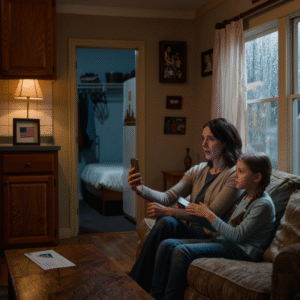
The apartment smelled faintly of citrus cleaner and freshly baked bread.
For a split second, I thought I had stepped into the wrong place. Then I wondered if someone had broken in. But Mason’s crooked drawing was still taped to the refrigerator, and my chipped coffee mug sat where I’d left it.
My stomach knotted.
The living room was… tidy. Not staged, just cared for.
The throw blanket was folded. The trash was gone.
And the sink—miraculously—was empty.
I heard movement from the kitchen. Ryan stood at the stove wearing one of my oversized T-shirts, his knee brace strapped on, shifting his weight carefully. A small loaf pan rested on the counter.
When he saw me, he lifted his hands slightly, palms open.
“I didn’t go into your bedroom,” he said right away. “Just cleaned out here.
It felt like the least I could do.”
My heart pounded. “How did you even—”
“I used to cook,” he said quietly.
“Before.”
On the table sat two grilled cheese sandwiches and a bowl of soup.
Not canned. I could see herbs floating on top. My exhaustion didn’t disappear.
It hardened into suspicion.
“You went through my cabinets.”
“I looked for ingredients,” he admitted. “I wrote down what I used.” He nodded toward a folded note beside my keys.
In careful handwriting: Used: bread, cheese, carrots, celery, broth cubes. Will replace.
Replace them how?
Mason came racing down the hallway, backpack bouncing. “Mom! Ryan fixed the door!”
I blinked.
“What door?”
“The front one!
It doesn’t stick anymore. And he made me finish my homework first.”
Ryan’s mouth twitched.
“He’s smart. Just needed quiet.”
I looked at the doorframe.
The wood no longer scraped.
The hinges were tightened. The deadbolt turned smoothly. Gratitude and unease tangled inside me.
“Where’d you learn that?” I asked.
“Construction. Maintenance work.
I handled facilities for a hospital contractor. Before I got hurt.”
The question slipped out sharper than I meant it.
“So how did you end up on the street?”
His eyes dropped.
“Worker’s comp stalled. Rent piled up. Then my sister—” He stopped.
“Doesn’t matter.”
I folded my arms, trying to feel steady in my own home.
“I said one night.”
“I know,” he answered. “I’m not planning to stay forever.
I just didn’t want to leave without balancing the risk you took.”
Then he reached into the pocket of my coat hanging over the chair and pulled out a neat stack of mail. My chest tightened.
“I didn’t open anything sealed,” he said quickly.
“That envelope was already open.”
The landlord’s notice. “You’re two warnings away from eviction,” he said gently. “I know.”
He studied me the way someone studies a broken machine—looking for a way to fix it.
“I can help,” he said.
“Not with cash. Not yet.
But with repairs. You tell your landlord you’ve got someone handling maintenance in exchange for time.”
A bitter laugh almost escaped me.
“You think he discounts rent for kindness?”
“No,” Ryan replied evenly.
“But some landlords understand leverage.”
Leverage. Strange word from someone who’d slept on cardboard. That night, after Mason fell asleep, I read the notice aloud: pay within ten days or vacate.
My hands shook.
“Let me see the building tomorrow,” Ryan said quietly. And I realized the surprise wasn’t the clean floors or the homemade soup.
It was that he looked at my life and didn’t see chaos. He saw strategy.
Saturday morning—my only day off—I half expected him to vanish.
Help usually came with strings. Or an exit. But at 7 a.m., he was still there, brace secured, hair damp from a shower, my toolbox open at his feet.
“I won’t leave unless you tell me to,” he said.
“And if I do, I’ll do it right.”
We walked to the building office—really a converted storage room behind the laundry area. Mr.
Turner glanced up from his desk. “Rent’s late,” he said flatly.
“I got the notice,” I replied.
His gaze shifted to Ryan. “And he is?”
“Not a tenant,” Ryan said calmly. “I’m here about the maintenance issues that keep getting ignored.”
Mr.
Turner scoffed.
“There are no issues.”
Ryan didn’t flinch. “Back stairwell light’s out.
Third-floor handrail’s loose. Dryer vent’s clogged—fire risk.
And 2B’s doorframe’s been misaligned for months.”
Turner’s expression tightened. “Who told you that?”
“The building did,” Ryan said. “It’s visible.”
Turner looked irritated.
“You bringing outsiders into this now?”
“I can fix it all in one day,” Ryan continued. “Minimal materials.
In return, you give her thirty days’ extension. In writing.”
“And why would I?” Mr.
Turner shot back.
Ryan nodded toward a water stain blooming on the laundry room ceiling. “Because if that vent sparks a fire and tenants report you ignored it, insurance will care. So will code enforcement.”
My stomach dropped.
He wasn’t bluffing.
Mr. Turner studied Ryan’s brace, then the toolbox.
Calculating. “Fine,” he muttered.
“Thirty days.
But if something breaks, she pays.”
Ryan slid a handwritten agreement across the desk. He’d drafted it the night before. Mr.
Turner signed with a grumble.
Outside, my knees felt weak. “How did you know what to say?”
“I used to be the guy landlords hired before inspectors showed up,” he answered.
By evening, the stairwell light worked. The rail was secure.
The vent was cleared.
He even fixed a loose outlet in my kitchen. Later that night, after Mason was asleep, Ryan placed folded paperwork on the table. “My disability claim,” he said.
“I found the case number.
I can reopen it Monday at the clinic. I stopped pushing when I got tired.”
“Why show me this?”
“Because you took me in,” he said simply.
“You deserve to know I’m trying.”
Relief caught in my throat so sharply it almost felt like grief. The following weeks weren’t magic.
Ryan didn’t suddenly become wealthy.
I didn’t suddenly stop working double shifts. But the apartment stopped deteriorating. Mr.
Turner stopped dismissing me.
Ryan reopened his case with help from legal aid, and when the first check came, it didn’t solve everything—but it stabilized him. One evening, Mason asked, “Is Ryan family now?”
I looked across the small kitchen.
Ryan’s brace leaned against the wall while he carefully stitched Mason’s torn backpack strap. He didn’t look up.
He just waited.
“I don’t know yet,” I told Mason honestly. “But he belongs here for now.”
Ryan’s voice softened. “You gave me a chance.”
I shook my head.
“You gave us one too.”
Because the real surprise wasn’t that a stranger could step up.
It was that when you offer kindness with nothing guaranteed in return, sometimes it comes back carrying more than you ever expected.