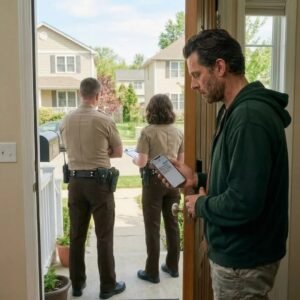
Blood ran from my nose onto my parents’ front step as I pounded on the door with my left fist.
My right arm hung useless against my side. Every breath scraped through me like broken glass. Twenty minutes earlier, my brother-in-law had slammed me into a granite counter because I refused to sign mortgage papers that would have tied my life to his debt.
My sister had stood there in her spotless cream sweater, watched it happen, and said only one thing.
“You should’ve signed.”
The porch light came on behind the frosted glass. I heard my mother’s voice, then the sound of the deadbolt turning, then a scream sharp enough to split the quiet street in Bryn Mawr in two.
I remember her hands flying to her mouth.
I remember my father pushing past her in socks and an old Navy sweatshirt.
I remember trying to say, “Don’t let them change the story.”
Then my knees buckled, my shoulder gave way, and the white-painted porch column rushed sideways across my vision.
That is how it began for everyone else.
For me, it had started three weeks earlier, at Sunday dinner, under the warm yellow light of my parents’ dining room chandelier, with chicken parmesan, garlic bread, and the kind of smiling family pressure that looks harmless until you realize it is designed to corner you.
My name is Jacqueline Morris. I was twenty-nine years old then, a pediatric nurse at Children’s Hospital of Philadelphia, and the quiet one in the family.
Not quiet because I had nothing to say. Quiet because my older sister Lauren had always taken up all the air in a room without seeming to. She had a talent for it.
She could make everyone feel as though whatever she wanted was the natural next step in the American story we were all supposed to tell ourselves: work hard, dress well, buy property, keep moving up.
Lauren had married Marcus Wheeler three years earlier. He was handsome in the polished way some men are polished on purpose, with perfect teeth, cuffed sleeves, and a realtor’s voice that always sounded one level friendlier than it was. He drove a black BMW, wore watches he liked to mention casually, and spoke about “opportunities” the way normal people talked about weather.
That Sunday, he arrived carrying a bakery box from Wayne and a bottle of Napa cabernet my mother treated like proof he was successful.
“We found it,” Lauren said before dessert even made it to the table.
Marcus leaned back in his chair, smiling.
“Four units in Ardmore. Beautiful old brick place, walking distance to the train, perfect for rental income. Seller wants out fast.
The numbers are unbelievable.”
My mother clasped her hands. “Oh, that’s wonderful. See, Robert?
I told you they were going somewhere.”
My father nodded, impressed in the careful way retired military men can be when they are trying not to show it too openly.
I smiled because that was what I usually did. I had no interest in real estate. My life ran on twelve-hour shifts, hand sanitizer, half-drunk coffee, and the small, fierce victories that happen in pediatric wards when a child smiles after a terrible night.
I rented a one-bedroom in the city, drove a modest Honda, and had never once wanted to impress anyone at a dinner table.
Lauren reached across the table and laid her manicured hand over mine.
“Which brings us to you.”
The room changed.
It is funny how quickly that happens. One sentence, and suddenly the clink of forks disappears. The grandfather clock in the hall seems louder.
Every face turns toward you as if the answer they need is not just expected but owed.
Marcus folded his napkin. “The banks are being conservative with investment properties right now. Temporary thing.
We’ve got the income. We’ve got the plan. We just need a co-signer to strengthen the application.”
“A family co-signer,” Lauren said gently.
“Just as a formality.”
I looked from one of them to the other. “You want me to co-sign a mortgage?”
Marcus gave a soft laugh. “Not really.
Not in the way people dramatize it. It’s just paperwork. We’d make the payments.
You’d never have to do anything.”
My nursing instincts are good. They have to be. In my line of work, you learn to hear the gap between what people say and what they mean.
Parents say their toddler “fell,” and the bruising tells a different story. A teenager says they are “fine,” and their eyes tell you they have not slept in days.
Marcus’s tone put that same cold little warning in the back of my neck.
“Can I see the loan terms first?” I asked. “The property records, your numbers, the mortgage details?”
His smile held, but his jaw tightened.
“If you trusted us,” Lauren said, “you wouldn’t need a packet.”
That was the first moment I knew something was wrong.
Not because they were asking.
Families ask each other for help every day. It was the speed with which the warmth disappeared when I asked a normal question. It was the way my mother lowered her fork and looked disappointed in me before I had even answered.
“Jacqueline,” she said, “they’re not strangers.”
“I know that, Mom.”
“Then why make this sound ugly?”
Because it already was.
But I didn’t say that.
I only said, “I’m not saying no. I’m saying I need to review what I’m signing.”
Marcus looked at Lauren. Lauren looked at my parents.
My parents looked at me the way families do when they want one person to be the reasonable one, which almost always means the one who gives in.
The pressure started the next morning.
I had barely finished morning rounds when Lauren texted.
Morning, sis. When can you sign?
I didn’t answer right away because I was starting an IV in a six-year-old who hated needles and needed my whole attention. By lunch I had seventeen texts and four missed calls.
We really need to move on this.
The seller won’t wait.
Why are you ignoring me?
I always help you when you need things.
I finally wrote back: I’m working.
I need time. We can talk this weekend.
Her reply came so quickly it felt like she had been holding the phone in her hand, watching the screen.
Time for what? It’s one signature.
Tuesday, she called me during my break in the cafeteria.
“Why are you acting like this?” she asked, voice sweet on the surface and brittle underneath.
“Marcus is humiliated. He put himself out there in front of the seller.”
“That’s not my responsibility.”
She laughed softly. “God, when did you get so suspicious?
This isn’t like you.”
“No,” I said. “What isn’t like me is signing six hundred thousand dollars’ worth of legal liability without reading anything.”
Silence.
Then, very calmly: “It wouldn’t be six hundred thousand to you.”
That wording stayed with me.
Wednesday, Marcus showed up at the hospital carrying takeout from a place I had mentioned once, maybe two years before. He charmed the charge nurse.
He joked with one of the respiratory therapists. He stood in a hallway full of cartoon murals and antiseptic light and made himself look like the devoted family man married to my sister.
“There’s my favorite sister-in-law,” he boomed.
My colleague Tracy smiled at me. “You’re lucky.”
I took the bag from him and said, “I’m about to start rounds.”
“I’ll walk with you.”
We moved down the corridor side by side, him smiling for the benefit of everyone watching.
“Lauren is hurt,” he said quietly when we were out of earshot.
“She feels like you don’t trust family.”
“This isn’t about trust.”
He kept smiling, but his eyes changed. “Then what’s it about?”
“Why do you need a co-signer if your finances are solid?”
He didn’t answer right away.
“Investment lending is bureaucratic,” he said at last. “You wouldn’t understand the way banks structure these things.”
There it was.
Condescension wrapped in charm.
I stopped walking. “Then explain it.”
He looked at me for a beat too long, then said, “Don’t make this harder than it has to be.”
Thursday, my parents joined the campaign.
My mother called while I was at Acme buying cereal and yogurt after a long shift.
“Lauren came by crying,” she said.
My stomach sank. “Did she tell you it requires me to co-sign a mortgage?”
“Oh, sweetheart, you make everything sound so severe.
It’s just support. Marcus would never let anything happen to your credit.”
“Mom, that’s not how the law works.”
Her tone cooled. “You have always been so quick to help strangers.
Your little patients, your co-workers, people at church. But your own sister asks for one thing and suddenly you’re a financial expert.”
My father called an hour later with a quieter version of the same message.
“Opportunity doesn’t knock twice,” he said.
He meant well, but that was the problem. In our family, Lauren’s ambition had always been treated like a virtue even when it came with damage trailing behind it.
Friday afternoon, a college friend texted me.
Did you already sign for Lauren?
She posted about “family supporting our new investment.”
Cold moved through me like water.
I opened Facebook.
There it was. A glossy photo of an old brick multi-unit building. Lauren in oversized sunglasses.
Marcus in loafers and that same salesman’s grin. The caption thanked “family who believe in our dreams.” He had tagged me with a heart.
I called immediately.
“What is this?”
“Oh, relax,” Lauren said. “I was excited.”
“Take it down.”
“People already saw it.”
“I do not care.
Take it down.”
She sighed, as if I were the difficult one. “You always make things so dramatic.”
That night, I stopped feeling guilty and started doing what I should have done sooner.
I opened my laptop and began looking.
Property records first. Business filings second.
Court databases third.
By midnight I had found the first lien.
By one in the morning I had found three.
By two I had found two lawsuits against Marcus from former clients, one involving concealed structural damage in a house sale, another involving an elderly widow who claimed he had manipulated her into selling below market value with promises that never materialized.
At two-thirteen, I found a notice of default on their own house in Radnor.
At two-forty, I found that Marcus had not been with the “premier real estate firm” he still casually named at dinner for over a year.
At three-oh-six, my phone buzzed with a credit monitoring alert.
Someone had pulled my credit report.
A second alert followed less than a minute later.
A mortgage application had been opened using my information.
I sat at my kitchen table in the weak glow from the under-cabinet light, surrounded by printed court records and cold coffee, and felt something harden inside me.
They had not been asking for help.
They had been preparing to take it whether I consented or not.
Saturday morning I called a lawyer.
Patricia Coleman listened without interrupting, then said, “You are describing identity misuse, attempted fraud, and coercive pressure. Possibly extortion if the threats escalate. Do not sign anything.
Document everything. And if anyone has used your information without permission, you need a police report.”
Then a text came from an unknown number.
Your sister says you’re signing Sunday. Smart choice.
Hate for things to get messy.
No name. No signature. Just that.
I screenshotted it and added it to the folder.
Saturday evening I called my parents and told them we needed to talk before Sunday dinner.
My mother cut me off.
“I am not listening to you smear your sister because you’re uncomfortable helping her.”
The line went dead.
That was when I understood the worst part of family manipulation.
It doesn’t just isolate you from the person hurting you. It drafts everyone else into protecting the lie.
Sunday arrived heavy and humid, the kind of late-summer Pennsylvania day where the air sits low over the Main Line and thunder threatens before noon. I parked behind Marcus’s BMW and sat for a moment with my hands on the steering wheel.
Through the dining room window, I could see them laughing.
My parents.
Lauren. Marcus.
The perfect family picture.
I picked up the folder of evidence from the passenger seat and walked to the door.
Lauren answered before I knocked.
“There you are.” Her smile looked expensive. “We were starting to worry.”
“I’m sure you were.”
She blinked once, then stepped aside.
“Marcus has everything ready.”
“Good,” I said. “So do I.”
We did not make it to dinner.
Marcus led me into the home office, dark wood desk, framed closing photos on the wall, fake authority in every carefully arranged detail. The mortgage application sat on the desk already filled in, my name typed into the co-signer line.
“See?” he said lightly.
“Everything’s ready. Just need signatures.”
I set my folder down beside it.
“Before we get there, why don’t we talk about your suspended licenses in New Jersey and Delaware.”
The color left his face so fast it was almost impressive.
Lauren closed the office door behind us. “What did you say?”
I opened the folder and spread the papers across his desk.
Liens. Court records. Default notices.
My credit alert. The incomplete mortgage application made with my information.
“You ran my credit without permission,” I said to Lauren. “You started a mortgage application in my name.
That is fraud.”
“We didn’t—” Marcus began.
I cut him off. “Your house is in pre-foreclosure. Your business is buried in debt.
This isn’t an investment opportunity. This is a bailout.”
The office door swung open.
My parents stood there.
My father’s eyes moved from the papers to Marcus, then to Lauren.
My mother looked as though she had walked into the wrong house.
“Lauren,” she said faintly. “What is this?”
Lauren sank into the leather chair as if her legs had given out.
“It’s temporary,” she said.
“We hit a rough patch.”
“A rough patch?” I held up the notice of default. “You were willing to make me legally responsible for hundreds of thousands of dollars.”
Marcus tried to recover. Men like him always do.
“You’re blowing this out of proportion. We just needed help getting over a financing hump.”
“And the threatening texts?”
His eyes flicked to mine.
“And the unauthorized inquiry? And the fake public post making it look like I’d already agreed?”
“Jacqueline,” Lauren said, voice breaking on cue, “please.
We’re desperate.”
My father picked up the default notice.
“How much?” he asked.
Marcus looked at Lauren. Lauren looked at the floor.
“How much?” my father repeated, his old command voice back in place.
“About six hundred thousand,” Marcus said.
My mother made a low sound I had never heard from her before.
Then Lauren did what she had always done when cornered.
She reached for the most emotionally expensive card on the table.
“I’m pregnant.”
It worked for a second. Of course it did.
My mother’s hand flew to her throat. My father froze. Even I felt the reflexive shock of it.
Lauren pressed a hand to her stomach.
“Four months. We’ve been trying for years. If we lose the house—”
I looked at her and saw the mechanism, not the sorrow.
“If you are pregnant,” I said carefully, “then you need real stability, not fraud.”
She stared at me as though I had committed the offense.
“How can you be this cold?”
“My sister,” I said, “used my information without my consent.
My brother-in-law tried to trap me into guaranteeing debt he hid. Don’t ask me to perform warmth so you can feel innocent.”
The room went still.
My father set the papers down.
“You told someone she was co-signing already,” he said to Marcus. “Didn’t you?”
Marcus did not answer fast enough.
I pulled out the last screenshot.
The unknown number. The threat.
My mother read it and sat down hard on the arm of the sofa.
“Who is this?” she whispered.
Marcus rubbed a hand over his face. “A private lender.”
“A loan shark,” I said.
No one corrected me.
That was the moment my parents finally saw the whole thing.
Not ambition.
Not temporary embarrassment. Not a misunderstood opportunity.
A collapse.
A lie built on another lie, with me shoved underneath as support.
“I’m not signing,” I said. “Not today.
Not tomorrow. Not ever. If my name appears on any document, I go to the police.”
Marcus’s mask slipped completely then.
It was the first time I saw the rage underneath the charm.
“You have no idea what you’re doing.”
“Actually,” I said, “I do.”
He took one hard step toward me before my father moved between us.
“That’s enough.”
My mother’s eyes were wet, but her voice was steady when she said, “You need to leave.”
“Mom—” Lauren started.
“You need to leave,” she repeated.
They went.
Not gracefully. Not repentantly. They left in the kind of hot silence that tells you the scene is not over, only interrupted.
My father locked the front door.
My mother turned to me and, for the first time in years, put both arms around me the way she had when I was little.
“I’m sorry,” she whispered. “I’m so sorry.”
I wanted that apology more than I wanted to admit.
But the worst part came later.
An hour after dark, the doorbell rang.
My father checked the peephole and said one word.
“Marcus.”
Rain had started by then. The porch light caught him soaked through, hair plastered to his forehead, shirt half untucked, the BMW idling at the curb.
He looked less like a polished realtor and more like a man whose life had finally become visible from the outside.
“I need to talk to Jacqueline,” he said through the storm door.
“Then talk,” my father replied. “From there.”
Marcus’s eyes found me over my father’s shoulder.
“You don’t understand,” he said. “These people don’t take no.
I told him she’d sign.”
“Told who?” my father asked.
Marcus ignored him. “If this deal dies, he’ll come after all of us.”
I stepped forward. “That sounds like your problem.”
His voice dropped.
“It became your problem when you decided to ruin this.”
“Ruin what?
Your fraud?”
He laughed once, a sharp, ugly sound. “You think you’re better than everyone because you work in a hospital and rent a little apartment in the city and don’t care about money. Some of us wanted more.”
“You could have wanted more without forging my future.”
That did it.
He lunged at the door.
My father moved faster than I expected for a seventy-year-old man with a rebuilt knee and a retired body.
He shoved the door shut against Marcus’s weight and reached for the deadbolt. Marcus grabbed my wrist through the opening before the lock caught.
“Sign the damn papers,” he hissed.
Pain shot up my arm.
My father struck his forearm hard enough to break the grip, then forced the door closed.
My mother called 911.
Marcus pounded once on the glass, then pointed at me through the rain.
“You’ll regret this.”
His tires squealed as he pulled away.
The police came. Statements were taken.
Photos of the bruise already forming around my wrist were logged. Officer Rodriguez, who had kind eyes and the patient manner of someone who had seen too many “family disputes” turn dangerous, advised me to stay somewhere safe.
Around three in the morning, Lauren called.
“Meet me tomorrow,” she said without preamble. “Doc Street Coffee.
Noon. Public place.”
“After tonight? No.”
Her voice changed.
Lost its polish.
“Tony went to our house,” she said. “Marcus promised him something to make him leave.”
My blood cooled.
“What?”
“You.”
I almost dropped the phone.
“He said you were signing Monday. If you don’t, Tony will collect from you directly.”
The next day, Lauren took off her sunglasses in the corner booth at Doc Street Coffee, and I saw a bruise blooming under one eye.
For one terrible second, my anger wavered.
“Marcus?” I asked.
She looked away.
“He said I should have handled you better.”
“Then leave him.”
“With what money?” She laughed bitterly. “With what life?”
We sat in the smell of espresso and burnt sugar while strollers rolled past outside on the sidewalk and the normal world went on pretending not to notice women crying in coffee shops.
Then she leaned forward and said the words that blew the last remnants of trust apart.
“Marcus already gave Tony documents showing you as guarantor.”
I stared at her.
“He forged them.”
The cafe blurred around the edges.
“You let him do that?”
“We were trying to survive.”
“No,” I said quietly. “You were trying to bury me under your choices.”
Marcus walked in then, unshaven and strangely calm, like a man who had passed through panic into something colder.
He set an envelope on the table.
“You have twenty-four hours.”
Inside were mortgage documents, guarantee forms, and enough paper to ruin three lives.
My father had parked outside. He saw Marcus leave, saw my face when I came out, and drove me straight to the FBI field office in Center City the next morning after I called out sick from work.
Agent Sarah Chen listened to everything.
When I said the name Anthony Torino, her expression changed.
“We’ve heard of him,” she said. “Off-book lending, construction fronts, intimidation.
If your brother-in-law is tied to him, this is bigger than family fraud.”
I wanted immediate safety, immediate arrests, immediate clarity.
Instead I got the truth.
These cases took time.
And time was exactly what I did not have.
By early afternoon, I insisted on going to my apartment to gather clothes, medication, and my passport. My father argued all the way there. I argued back.
We compromised on five minutes.
The building looked normal. The front desk smelled faintly of lemon cleaner. The security guard waved us through.
The elevator hummed upward. The hallway was quiet.
My apartment door stood open an inch.
My father whispered, “Back to the elevator.”
Then I heard crying from inside.
A woman.
Lauren.
I pushed the door open before reason could catch up with me.
She was on the floor near the couch, one hand pressed to her abdomen, blood staining her jeans, her face more bruised than the day before.
“Help me,” she whispered.
My training overrode my fear. I dropped beside her.
“How long have you been bleeding?”
The front door slammed.
Marcus stepped out from behind it holding a baseball bat.
He did not look panicked anymore.
He looked finished.
“You always come running,” he said to Lauren. “I told you she would.”
The horror of it landed in pieces. Lauren’s injuries.
The door shut behind us. The bat in his hands. The papers tucked under his arm.
“You used her as bait,” I said.
Lauren started crying harder.
My father stepped between us.
“Put it down.”
Marcus laughed.
“Get out of my way.”
He swung before any of us were ready.
The bat clipped my father’s shoulder and sent him crashing into the wall. I heard the impact of bone and plaster. I reached for him and Marcus blocked me.
“Sign.”
He slapped the papers against the kitchen counter with one hand and raised the bat with the other.
My entire body went cold and clear.
“Marcus,” I said, trying to keep him talking.
“This won’t fix anything. Tony won’t stop with one signature.”
“Not your concern.”
“It becomes my concern the moment I sign.”
His mouth twisted. “Should have thought of that when saying no was still cute.”
He raised the bat again.
I grabbed the papers and pretended to reach for a pen.
Then I flung them in his face and ran for the kitchen.
The bat smashed into the wall behind me.
Plaster sprayed over the counter.
I grabbed the first thing my hand found from the knife block and turned with the blade shaking in front of me.
“Back off.”
He smiled in a way I will never forget.
“You won’t use that.”
Not because I was good. Not because I was weak.
Because he thought he already knew the ending.
He came at me anyway.
I slashed blindly and caught his sleeve. The knife nicked skin.
He cursed and swung. Pain exploded in my shoulder. Something tore loose.
The knife flew from my hand.
I hit the counter hard enough to knock the breath out of myself.
My father, who should not have been able to stand yet, tackled Marcus from the side.
They went down.
Lauren dragged herself toward the door.
I grabbed the edge of the counter, hauled myself upright with my left arm, and staggered for the hallway.
Marcus broke free.
The next swing caught my ribs.
The one after that glanced off my face.
The world flashed white.
I remember the metallic taste in my mouth.
I remember my father shouting my name.
I remember Lauren saying, almost angrily, “You should have just signed.”
Even then.
Even on my floor.
Even with the bat in the room.
The sirens saved us.
Or maybe the building’s front desk saved us by calling them.
Either way, Marcus heard them and fled out the main door.
My father got me to the service elevator.
He half-carried me to the parking garage, with Lauren stumbling behind us and leaving a thin dark trail that I still saw in dreams for months after.
I should have let him take me to the hospital.
Instead I said, “Home.”
“Jackie, no,” he said.
“Home first.”
Because I knew stories change fast in families like mine. Bruises get explained away. Violence gets softened.
Fear gets translated into stress and misunderstanding and “things just got out of hand.”
I needed my mother to hear it from me while the blood was still on my mouth.
That is how I ended up on my parents’ lawn trying to stay conscious long enough to tell the truth.
The ambulance took me to Jefferson.
Three cracked ribs. A dislocated shoulder. A broken nose.
Facial injuries. Concussion.
When they reset my shoulder, I screamed until the room tipped black around the edges.
When I woke again, my mother was beside the bed in a chair, looking ten years older.
My father stood by the window in the same Navy sweatshirt, now stiff with dried rain and somebody else’s blood.
“Arrested,” my father said.
“Lauren?”
My mother looked down. “Surgery.
Complications from… something she did before. The doctors are sorting it out.”
Later we learned the pregnancy had not been what she claimed. There had been losses before.
There had been lies layered over grief, and fear layered over lies, until even she seemed unable to say where the performance ended and the damage began.
The detective came.
Then the FBI.
They had my phone. The recording had captured almost everything from the moment I entered the apartment.
“Attempted murder,” Detective Williams said flatly after hearing it.
I stared at him.
He nodded once. “He beat you with a bat while demanding signatures.
There’s no softer name for that.”
Marcus was charged. Lauren was charged too, though more carefully, more slowly, as the fraud investigation widened.
Because the deeper they dug, the uglier it got.
The “investment property” had not just been a bailout. It had been part of a money-laundering structure tied to Anthony Torino’s network.
Marcus had been helping move dirty money through shell property deals. My clean credit, my respectable career, my bland little life that had once seemed uninteresting compared to Lauren’s bright ambition, had been exactly what made me useful.
I had not only been a financial target.
I had been a laundering strategy in scrubs.
Marcus turned state’s evidence almost immediately.
Self-preservation is a powerful religion.
He gave up names, fronts, numbers, safe addresses, and one especially devastating piece of information: someone in law enforcement had been protecting Torino’s operations.
The hidden proof, he said, was in a safety deposit box, and the key was hidden in an old jewelry box Lauren kept in the bottom drawer of her childhood dresser in my parents’ house.
My mother found the key herself.
I can still see her standing there in the doorway of Lauren’s old room, holding that little brass key in her palm as though it weighed fifty pounds.
The recordings in the box blew the case open.
Torino’s voice.
Payments.
Threats.
Meeting details.
And a police captain whose name made every agent in the room go still.
That should have been the end of it.
But men like Anthony Torino do not let a case end cleanly.
During a transfer, Marcus disappeared.
Two marshals died.
The transport van was found empty on a service road.
Then my phone rang.
“Ms. Morris,” said a smooth male voice, cultured and almost bored, “I believe you have something my cousin would like returned.”
Vincent Torino.
Anthony’s cousin.
He had Marcus.
He wanted the recordings.
There are moments in life when fear is so complete it becomes almost calm.
That call was one of mine.
The FBI wanted me in witness protection.
My father wanted me out of Pennsylvania.
My mother wanted every door locked and every curtain closed.
But running would not save us if the organization kept standing. All it would do was move the fear to a different zip code.
So we made a plan that would have sounded insane to me a month earlier.
The FBI created edited copies of the recordings. Enough truth to look real.
Enough missing to buy time.
And I agreed to be the bait.
The exchange was set for an abandoned textile warehouse north of the city on a gray Tuesday morning. Rain streaked the windshield of my Honda. My ribs still ached when I breathed too deep.
The wire taped beneath my sweatshirt felt hot against healing skin.
“Six units in position,” Agent Chen said in my earpiece. “You do not have to do this.”
But I did.
Not for Marcus. Not even close.
For the ending of the story.
For my parents.
For every future version of me that deserved a life not lived looking over her shoulder forever.
A man in a black SUV took my phone and patted me down.
I climbed rusted stairs inside the factory and walked into a room that smelled like wet concrete and old oil.
Marcus hung from a support beam with his wrists chained overhead.
He looked smaller than I had ever seen him. Human, finally. Bruised, bloodied, stripped of the performance that had once made women in nice blouses trust him with mortgages.
Vincent Torino sat at a metal desk as though the place belonged to him.
“Thank you for coming,” he said.
I handed over the drives.
He listened.
Then he smiled faintly.
“Edited.”
My stomach dropped.
He rose from the chair and drove a knife into Marcus’s thigh with such calm efficiency that I heard myself make a sound before I understood it was mine.
Marcus screamed.
“Tell her,” Vincent said, “to give us the real files.”
He really had changed in some ways by then.
Or maybe pain makes honesty easier.
“I gave you everything,” he gasped. “That was everything.”
Vincent nodded to one of his men.
They moved toward Marcus again.
I did not think.
I moved.
There was a rusted pipe on the floor. I swung it at the nearest man’s knee.
Bone cracked. He went down. Another reached for his gun.
Marcus, with whatever strength terror and desperation can summon in a broken man, kicked backward hard enough to throw his aim. The shot shattered a window.
Then the room exploded with shouting, boots, flash-bangs, and FBI jackets.
The rest was noise and light and the thud of bodies hitting concrete.
When Agent Chen got to me, I was on my knees, one hand braced against the floor, blood running from my nose again, chest heaving like I had run miles.
“You okay?” she shouted.
I looked toward Marcus. Paramedics were cutting him down.
That answer was all I cared about.
Torino’s network did not survive the week.
Not once the recordings came in clean.
Not once the corrupt captain was arrested. Not once Marcus and Lauren both agreed to testify.
Anthony Torino was denied bail.
Vincent was charged.
The shell companies were frozen.
The headlines shifted from “family mortgage dispute turns violent” to “major financial crime and corruption case tied to suburban fraud scheme.”
My name was eventually reported.
That should have humiliated me.
Instead, something strange happened.
People started calling.
First former patients’ parents. Then nurses from my hospital.
Then strangers.
A woman in Lancaster whose son had stolen against her house.
A retired teacher in Bucks County whose niece had pressured him into “temporary” debt.
A man in Delaware County whose brothers were trying to force him into guaranteeing a business loan.
It turned out that behind polished family Christmas cards and polite church smiles and backyard graduation parties, people were being financially hunted by their own relatives every single day.
Detective Williams came to my parents’ dining room one afternoon with another folder.
“Marcus had other victims,” he said. “At least twelve.”
I looked at the names.
Elderly couples. A widower.
A cousin. Former clients who had trusted the handshakes, the jokes, the friendly texts.
When I asked if they could recover anything, he said, “Maybe. With the assets we’ve frozen.”
That word stayed with me.
Recover.
It is a hospital word.
A family word. A legal word. A prayer.
Lauren took a plea deal.
She testified against Marcus and the Torino network and entered witness protection afterward.
We were allowed one final supervised conversation in the hospital before she disappeared into another name.
She looked small in the bed. Smaller than the older sister who used to do my eyeliner for school dances. Smaller than the woman who had sat in coffee shops insisting my destruction was simply family duty.
“I don’t deserve you coming here,” she said.
“No,” I said.
“You don’t.”
She looked at her hands. “I had miscarriages. More than one.
I started lying because the truth felt like another failure Marcus could hold against me.”
I sat quietly.
“That doesn’t excuse any of it,” she said quickly.
“No.”
“I know.”
We stayed with the truth for a while then, bare and unpleasant and finally free of decorations.
When she left under federal supervision a few days later, I did not cry until after the car was gone.
Marcus survived the warehouse rescue and went to prison after testifying.
He would not stay there forever.
Not alive, anyway.
But that came later.
The trial against Anthony Torino lasted months.
I testified in federal court with my shoulder still not fully healed, my nose still slightly tender in cold weather, and a thin scar on my lip that makeup could soften but not erase.
Torino stared at me as if trying to memorize what I had cost him.
The defense tried to make me look vindictive. Overdramatic. Emotionally unstable after a family disagreement gone wrong.
Then the prosecutor played my recording.
The room heard the bat strike the wall.
Heard Marcus demand the signatures.
Heard my father shouting.
Heard enough.
Torino was convicted.
Life without parole.
Vincent too.
The corrupt captain went down beside them.
By then, my body had healed enough for me to return to the hospital on light duty.
The first day back, one of my little leukemia patients handed me a crayon card that read, Nurse Jackie, you helped me be brave.
Now I send brave back to you.
I cried in the supply closet for ten straight minutes.
That was also around the time Patricia Coleman found me.
She had once been a victim too. Her brother-in-law had tried to pull her into a fraudulent development scheme years before. She had turned the aftermath into a nonprofit that helped families fight financial abuse.
“You have a voice people trust,” she told me over coffee in a quiet corner booth in Center City.
“Not because you’re polished. Because you’re not. Because people can tell you paid for every word.”
I started part-time.
One support group became two.
One legislative hearing became three.
I still worked shifts in the hospital, still learned tiny fighters’ names, still adjusted oxygen, still celebrated good scans and grieved bad ones.
But in the evenings and on weekends, I helped people untangle the legal and emotional knots left by relatives who thought love meant access.
Months later, Marcus asked to see me.
I almost refused.
Then Detective Williams told me there were more victims, more records, more families who might recover if Marcus cooperated fully.
So I drove to the federal facility.
He looked older. Emptier. Prison had stripped him down to something less impressive and, somehow, more true.
“I have names,” he said.
“Twelve. Maybe more.”
He slid a paper across the table.
I took it.
“Why now?” I asked.
He looked past me to the block wall. “Because I dream about them.
Because I don’t know what else to do with what I was.”
It was not redemption. Not to me.
But it was something.
And for the people on that paper, it mattered.
One year after the attack, Pennsylvania passed legislation strengthening penalties for family financial fraud and creating better reporting pathways for suspicious co-signing and coercive debt schemes. I testified for that bill in Harrisburg with my hand flat on the podium to keep it from shaking.
Afterward, reporters asked me whether I regretted refusing to sign in the first place, given all that followed.
“No,” I said.
I did not say it loudly.
I did not need to.
The ripple effect kept widening.
Families called.
Hospitals invited me to speak.
Banks updated internal training.
Victims found one another.
And somewhere out west, under a different name, Lauren began building another life.
I knew because a year after the trial, I received a letter forwarded through official channels with no return address.
She was living quietly.
Working at a clinic. Volunteering at a women’s shelter on weekends. She wrote that she would never ask for forgiveness because she had no right to.
Only that she was trying to become someone a child could trust.
I did not know then that she was pregnant again.
I learned that much later.
I also learned that Anthony Torino died in prison before his first full appeal was even finished.
A heart attack, they said.
No dramatic last words.
No poetic justice.
Just a body in a federal facility and a criminal empire collapsing into paperwork and auction inventories.
Marcus lasted longer.
Not forever.
He was attacked in custody years later by people with long memories and longer grudges. Before he died, his mother called me. I went once, for information, not sentiment.
He was pale beneath the hospital lights.
“She’s pregnant,” he whispered.
He nodded.
The news landed somewhere between grief and relief.
“She wanted you to know,” he said.
“Said the baby deserves a different story.”
Then he asked whether the families he had harmed had gotten help.
I told him yes.
That was the only comfort I gave him.
When he died the next week, I felt no triumph.
Only closure.
Life did what it always does after even the worst things.
It kept moving.
I moved into a new apartment because I could not go back to the old one without hearing the elevator and thinking of the service hallway, the blood trail, the open door. I kept working in the hospital. I kept testifying.
I kept helping families say no without apologizing for it.
Five years after I collapsed on my parents’ doorstep, I stood in my childhood bedroom in a wedding dress, looking at myself in the mirror.
The scar on my lip had faded to a fine white line. My shoulder still tightened before storms. Some injuries become weather inside you.
They do not leave. They only learn better manners.
My mother stood behind me fastening the pearl necklace twelve recovered families had bought together as a gift when they heard I was getting married.
“You look beautiful,” she said, and cried before I did.
Outside, white folding chairs had been set up on the same lawn where I had once knelt in blood and rain trying not to pass out before telling the truth.
We chose the house on purpose.
Not because we wanted to pretend nothing bad had happened there.
Because we wanted to reclaim it.
My father, in his best dark suit, took my arm at the back door. His hand shook once and only once.
“My warrior daughter,” he said.
I laughed softly.
“Dad.”
“It’s true.”
At the end of the aisle stood James Chen, a trauma nurse I had met at a conference on family violence and coercive control. He had known my story before our first date. He had watched me testify on C-SPAN.
He had read the articles and still asked me to dinner without ever making my pain sound glamorous.
“You are not defined by what happened to you,” he told me on our third date. “You’re defined by what you built after.”
I loved him a little for that before I fully admitted it to myself.
The yard was full.
My hospital people.
My parents’ neighbors.
Detective Williams, retired by then but still watchful.
Agent Chen, now with a bigger title and the same unreadable face.
Patricia Coleman.
Families I had helped.
And in the front row, a little girl in a flower crown who had once been a tiny leukemia patient and was now eleven and full of impossible life.
When Dad placed my hand in James’s, the house behind us seemed to exhale.
The vows were simple. Ours, not borrowed.
James promised to stand with me in truth, not comfort.
I promised to build a life with him that never required performance to feel secure.
When the officiant pronounced us husband and wife, the applause rose over the backyard, over the porch, over the place where the worst night of my life had once begun to turn.
During the reception, I noticed a woman in sunglasses seated alone in the back row for less than five minutes before she disappeared.
Security found only an envelope left behind.
Inside was a note in handwriting I recognized before my mind let me.
Jay,
I know I should not be here.
I know what it risks. But I couldn’t miss watching my little sister marry a good man in the yard where she rebuilt her life. I was the one who broke our family.
You were the one who taught me it was still possible to tell the truth after that. The little one sends a kiss she doesn’t know she’s sending. Be loved.
Be safe. Be everything I forgot how to be.
Always your sister,
L.
I folded the note and put it back into the envelope.
James came up beside me. “You okay?”
I looked out over the yard.
My mother laughing with Sharon from the hospital. My father teaching one of the kids how to hold a sparkler safely. Patricia talking policy near the buffet table.
Detective Williams pretending not to dance. The porch light glowing gold against the old white siding.
And I thought of the porch step where I had once collapsed believing the story might end there.
“I’m okay,” I said.
It was one of the few times in my life the words were completely true.
Later that night, after the last guest left and the folding chairs stood empty under the stars, James and I sat on the porch swing.
From there I could see the walkway where my blood had once dripped onto the concrete. My mother had scrubbed it twice.
My father had replaced the cracked porch tile himself. We had all done what families do when they decide, too late but still sincerely, to become the kind of people one another deserved.
“Any regrets?” James asked.
“About today?”
“About choosing this place.”
I looked at the house.
The walls that had heard my mother scream when she opened the door.
The front room where detectives took statements.
The kitchen where my father made tea with shaking hands while the police car lights flashed across the ceiling.
The yard where we were married.
“No,” I said. “Not about this.”
He leaned back, one arm draped along the swing.
“You transformed it.”
I smiled and rested my head against his shoulder.
“No,” I said softly.
“We did.”
Inside, my parents were still awake, moving dishes, saving leftover cake, speaking in the low ordinary tones of people whose home had finally become just a home again.
Upstairs, my old room was now a guest room. The glow-in-the-dark stars were gone, replaced by real age and good paint and the faint smell of clean linen. Life had kept going there too.
That is what I understand now, after all of it.
People talk about survival as if it is one moment.
One decision. One heroic refusal.
It is not.
It is saying no at the dining table when everyone wants your yes.
It is screenshotting the text instead of explaining it away.
It is asking to see the documents.
It is calling a lawyer.
It is telling the truth before shame can rearrange it.
It is choosing not to sign your life over just because the person asking shares your blood.
It is waking up in a hospital bed and deciding the story is still yours.
It is going back to work.
It is helping the next family.
It is standing at a podium when your voice still shakes.
It is letting yourself be loved by someone who does not need your destruction in order to feel important.
And sometimes, if you are lucky, it is sitting on a porch swing years later with a ring on your finger and stars above you, realizing that the same doorway where you once begged for help is now the doorway you walked through in silk and laughter.
I used to think saying no had nearly cost me everything.
Now I know the truth.
It saved everything worth keeping.