My husband never knew that I owned the company where his father worked.
At those long Sunday family dinners in Atlanta, he let everyone believe I was just a quiet woman who had gotten lucky and bought a place before the market went wild. I let him believe it, too. I let his whole family believe I was the modest wife with the little online boutique, the woman with decent manners, soft voice, and no real leverage in a room full of people who mistook arrogance for power.
I wanted to see how they would treat me if they thought I had nothing they needed to respect.
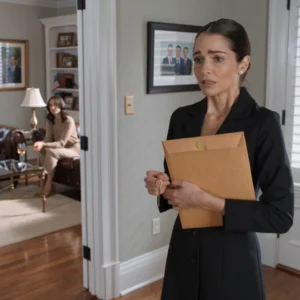
I got my answer on a humid Sunday evening in my in-laws’ backyard, with smoked brisket in the air, sweet corn on the grill, and a heavy brown envelope sliding across a cedar table toward my plate like a loaded weapon.
What happened after that did not just end a marriage.
It brought down an entire family.
My name is Naomi.
I was thirty-two then, and by every measure that mattered, I had already built a life most people would have spent decades chasing. I had built it quietly, carefully, and without asking anyone for permission. That was exactly why the Vance family could not see it.
They only saw what fed their own story.
They saw Marcus, my husband, in pressed shirts and polished loafers, talking like a man who understood money.
They saw his father, Thomas, with his big voice and bigger ego, sitting at the head of every table like a king in a backyard kingdom. They saw Beatrice, my mother-in-law, with her church pearls, country-club posture, and iron-fisted devotion to the family image. They saw Julian, the favored younger son, forever chasing flashy opportunities.
They saw Chloe, Julian’s wife, with her expensive taste, manicured hands, and the particular kind of confidence that only comes from a life where consequences always seem to land on someone else.
And then there was me.
The woman they thought Marcus had married out of pity, convenience, or temporary fascination.
The woman they believed should feel grateful just to be included.
The woman they assumed could be pushed.
That Sunday, the air in their backyard felt thick enough to wear. The patio stones were still holding the day’s heat. Beyond the fence, cicadas hummed in the trees, and someone a few houses over had a football game on too loud.
The Vances lived in one of those old-money-adjacent Atlanta neighborhoods where everyone had a flagstone patio, a stainless grill, and just enough landscaping to suggest money without ever admitting to it.
We were seated around Beatrice’s beloved cedar dining table, the one she called “the heart of the family,” though what she really meant was the place where she controlled the room.
Thomas sat at the head, blotting barbecue sauce from his mouth with a linen napkin like he was finishing a board meeting instead of eating ribs in a polo shirt. Marcus sat beside me with a sweating beer bottle in his hand. Julian and Chloe were across from us.
Beatrice floated in and out of the conversation, refilling glasses, issuing opinions, correcting details nobody had asked her to correct.
I had already noticed the leather briefcase on the deck near Thomas’s chair.
That was never a good sign.
Thomas did not bring paperwork to family dinner unless he planned to make something sound official enough that nobody felt entitled to argue.
He reached down, opened the case, and pulled out a thick manila envelope. The slap of it against the table cut straight through the casual chatter.
Everyone went quiet.
He slid it toward me.
It stopped against my plate.
On the front, in bold letters, were the words: Postnuptial asset mortgage agreement.
I looked at the envelope. Then at him.
For a second, nobody moved.
Not even Beatrice.
Thomas cleared his throat.
“Open it, Naomi.”
He said my name the way men like him say the names of people they’ve already decided should cooperate.
I picked up the envelope and removed the papers inside. Crisp legal pages. Clean print.
Tabs. Signatures marked in yellow. The whole thing carefully prepared, as if my consent were the last minor formality standing between them and something they had already decided belonged to them.
I kept my voice level.
“What is this, Thomas?”
He leaned back in his chair and crossed his arms over his chest.
“This,” he said, “is the solution to our current family setback.”
Julian looked down, pretending to inspect his plate, but I caught the nervous energy in his leg beneath the table.
Marcus took another sip of beer and still did not meet my eyes.
Thomas continued.
“Julian has a major opportunity in front of him. A serious expansion. Real money.
The kind of move that changes a family’s future. He just needs capital to bridge the next phase.”
Beatrice nodded solemnly, as if she were listening to a sermon instead of a setup.
“Your father-in-law and I have already done our part,” she said.
Thomas gestured toward the pages in my hands.
“Now it’s your turn.”
I said nothing.
He took my silence as permission.
“You are going to sign that agreement and mortgage the property you brought into the marriage. The bank wants collateral with clean equity.
Your home has more than enough. Julian can use that to secure the business loan, scale the fund, and pay everything back within six months. With interest.”
There are moments in life when shock feels almost physical.
Not because you do not understand what is being said, but because you understand it too well.
I looked down at the paperwork again.
It was worse than I had expected.
The language was dressed up to sound temporary, strategic, family-centered. But the structure underneath it was clear. The equity from my property would be tied up under the control of Thomas as primary guarantor.
The liability exposure was lopsided. The clauses were slippery. One bad step, one “delay,” one “restructuring,” and I would be the one carrying the loss while they walked away calling it an unfortunate market event.
It was not help.
It was a trap in business-casual clothing.
Before I could speak, Chloe set down her fork, dabbed the corner of her mouth with her napkin, and smiled across the table.
“Honestly, Naomi, this shouldn’t even be a hard decision.”
Her voice had that smooth, polished sweetness some women use when they want cruelty to pass for reason.
“Julian is trying to build something meaningful.
Generational wealth. A real legacy. And all you’re being asked to do is use an asset that’s just sitting there.”
She glanced at Marcus.
“Especially when Marcus works so hard to carry the real load.”
There it was.
The usual arrangement.
Belittle me first.
Then praise the men. Then call the theft sacrifice.
Chloe lifted her glass of sparkling water and took a small sip before continuing.
“Your little online shop is cute. It really is.
But let’s be serious. It’s not creating the kind of capital that changes a family tree. Julian’s move actually could.
So yes, I think helping him is the least you can do.”
Beatrice set down her fork a little harder than necessary.
“Chloe is exactly right.”
She turned fully toward me, her eyes narrowing.
“When you came into this family, you came in with a cheap degree and a lot of struggle. Marcus has worked incredibly hard to provide stability. That property should function like family property now.
It is selfish to keep your finances separate when this family is on the edge of something big.”
I turned to Marcus.
That was the moment that mattered.
We had discussed that property before we ever married. He knew exactly what it meant to me. He knew I had bought it on my own, when nobody was promising me security and nobody was offering me a soft place to land.
He knew it was the one asset I had refused to blend, gift, or compromise.
He knew.
He still would not look at me.
Instead he took a long drink of beer, exhaled through his nose, and said, almost under his breath, “Come on, babe. Dad already ran the numbers.”
I stared at him.
He kept going, emboldened now that the room was leaning his way.
“It makes sense. Julian pays it back in six months.
It’s a temporary lien, not a giveaway. Family helps family. Just sign it and let’s not ruin Sunday over something that’s ultimately a smart move.”
A cold, steady knot formed in my stomach.
Not because I was afraid.
Because suddenly, with almost painful clarity, I saw how small they thought I was.
They truly believed I was dependent on Marcus.
They believed my business was a hobby. They believed my silence meant weakness and my restraint meant ignorance. They believed they were the adults in the room and I was the sentimental obstacle attached to a useful deed.
What they did not know was that Marcus had lost his job three months earlier.
They did not know that his severance had dried up.
They did not know that the credit cards keeping his carefully curated life afloat were tied to accounts I paid in full every month.
And they definitely did not know that the “little online boutique” they mocked was a shell description I had given years ago to protect something much larger.
Apex Horizon Group.
My company.
My logistics firm.
My infrastructure machine.
Over four hundred employees in the Southeast division alone, thousands of contracts in motion across the country, billions in freight movement worldwide.
And Thomas—booming, self-important Thomas—was one of my regional directors.
He had spent four years bragging at family dinners about his corporate status, his office, his numbers, his executive instincts, his demanding mysterious CEO.
He had never once realized that the woman he was insulting over deviled eggs and barbecue sauce was the woman who signed off on the structure that paid him.
I looked back down at the pages.
Thomas mistook that for hesitation.
He smiled.
Julian leaned forward, eager.
Chloe resumed cutting her steak, pleased with herself.
Instead of reaching for the pen beside my plate, I gripped the thick packet with both hands.
And I tore it in half.
The sound cracked through the backyard like a gunshot.
Nobody breathed.
I tore the remaining pages again, then again, until the neat stack of documents was a mess of ragged legal confetti in my hands.
Then I stood up and dropped the pieces onto Marcus’s plate, right over his half-finished brisket.
“No.”
My voice was quiet, but it cut clean through the silence.
“I will not mortgage my property to fund a fantasy.
I will not sign away my security so Julian can play entrepreneur with other people’s assets. And I will not sign anything you put in front of me today, next week, or ever.”
Beatrice gasped as if I had physically struck her.
Thomas’s face darkened so fast it looked almost dangerous.
Marcus let his beer bottle slip from his hand. It hit the deck with a sharp clatter and rolled beneath the table.
Nobody moved to pick it up.
Nobody reached for a fork.
You could feel the whole dinner shift from performance into war.
Chloe recovered first.
She let out a small laugh, leaned back, crossed one leg over the other, and gave me the kind of pitying look reserved for people she believes are embarrassing themselves in public.
“Naomi,” she said, “you are being unbelievably dramatic.”
That encouraged her.
“You need to calm down and look at this logically.
This is how serious families handle money. Real estate equity becomes working capital. That’s not exploitation.
That’s financial literacy.”
She tilted her head with a patronizing little smile.
“I know you didn’t grow up around this kind of thing, but that doesn’t make it wrong.”
I just watched her.
She mistook my silence for confusion and doubled down.
“Your boutique is a nice little side business. Nobody’s taking that away from you. But it’s not a legacy play.
Julian’s opportunity is. Sometimes you have to step aside and let people who understand the bigger picture make the calls.”
Thomas nodded at that, pleased.
“Knew there was a reason I liked that girl,” he said.
Then he fixed his eyes on me.
“You’re showing your true colors, Naomi. We brought you to this table and this is how you repay us?
By throwing a tantrum over paperwork?”
I did not look at Thomas.
I did not look at Chloe.
I looked directly at my husband.
“Marcus.”
He finally met my eyes.
“Are you really going to sit there and let them talk to me like this?”
He swallowed.
I went on.
“Are you going to let your father try to corner me into signing away my property while Chloe insults my business and your mother tells me my life belongs to this family? Are you going to say nothing?”
He clenched his jaw.
I leaned slightly toward him.
“Tell them the truth, Marcus. Tell them who has been paying the mortgage.
Tell them whose credit cards you’ve been using for the last three months.”
He flinched.
Thomas’s head snapped toward him.
For a moment I saw pure panic in Marcus’s face, that brief helpless panic of a man whose lies are standing too close together.
Then his pride took over.
He slammed both palms down on the table hard enough to rattle the glasses.
“Shut your mouth, Naomi.”
The whole yard went still.
He was red now. Angry. Humiliated.
Desperate enough to choose the ugliest version of himself.
“You’re embarrassing me,” he snapped. “You’re embarrassing yourself. Chloe is right.
You don’t understand how these things work. I’m the one with the finance background. I’m the one who knows what a good investment looks like.
Julian needs help, and you are being selfish.”
The man beside me no longer looked familiar.
“You want me to risk my property for Julian’s crypto mess?”
“It’s not a mess,” he shot back. “And it’s not just your property. We’re married.
What’s yours is supposed to be mine. But you’ve always held that place over my head. You’ve always used separate finances to make me look small.”
Not partnership.
Entitlement.
Not love.
Scorekeeping.
“My father is right,” he said.
“You don’t know the first thing about loyalty.”
Even Julian looked uncomfortable at that.
Beatrice sat very straight, triumphant.
Chloe took another sip of sparkling water, satisfied that the room had finally put me back where she believed I belonged.
I looked at Marcus for a long, long second.
I expected heartbreak.
I expected that sting behind the eyes, the hot pressure of grief when someone you trusted says the one thing that changes your understanding of them forever.
But no tears came.
What came instead was clarity.
A sharp, freezing, almost elegant clarity.
I saw him exactly as he was: a weak man who needed approval more than truth, a husband willing to feed his wife to his family if it meant his father might finally look at him like he mattered.
I picked up my jacket from the back of my chair.
Then my purse.
A custom leather tote I had bought for myself in Milan after closing a deal no one at that table could have understood even if I had diagrammed it for them.
“What are you doing?” Marcus asked, suddenly uncertain.
“I’m leaving.”
“You are not walking out in the middle of this.”
I slipped the strap onto my shoulder.
“We’re done talking, Marcus.”
He stood halfway, stunned.
Thomas’s voice boomed across the patio.
“You do not get to walk away from this conversation.”
I turned, finally, and looked straight at him.
“Watch me.”
I started across the patio stones toward the side gate.
Behind me, Beatrice’s chair scraped hard against the deck.
“Don’t you dare,” she shouted. “Don’t you dare walk out on us when we are speaking to you.”
I kept walking.
Her voice sharpened into something uglier.
“You ungrateful little brat. We gave you a family.
We gave you a place at this table. You came from nothing.”
The gate latch was cool beneath my hand.
Then she said the thing she had probably wanted to say for years.
“You have no parents. No pedigree.
You are an orphan. Once you walk out of here, don’t even think about coming back.”
I opened the gate and left without turning around.
The drive back into the city felt strangely quiet.
Atlanta at night always had two faces—glittering glass and old heat, sharp new money and the soft old sprawl beneath it. The lights along Peachtree blurred through my windshield.
The skyline floated in the distance like something staged. I drove in silence, one hand steady on the wheel, my mind already moving faster than the car.
By the time I pulled into the private garage beneath the tower where Marcus and I lived, I was no longer angry in the way most people mean anger.
I was focused.
Our penthouse sat high above the city, all glass walls and clean lines, the sort of place Marcus loved taking photos in when he wanted people to think success had arrived through him. When I walked inside, the silence felt almost medicinal after the chaos of the Vance backyard.
I poured a glass of red wine and never touched it.
I paced from one end of the living room to the other, watching my reflection move across the dark windows.
I pointed at my own reflection once, as if I were already speaking to him.
I waited.
Just after midnight, the front door unlocked.
Marcus came in smelling like cheap scotch, cigar smoke, and the sour remains of a damaged ego.
He tossed his keys onto the entry table and came straight toward me.
He didn’t look guilty.
He looked furious.
“You made a fool out of me tonight.”
His voice echoed in the open room.
He yanked at his collar, threw his jacket over a chair, and kept coming.
“You humiliated my father in his own house.
You disrespected my entire family in front of Julian and Chloe. We bring you into a real family, we give you a seat at the table, and you act like that over a simple business proposition?”
I turned away from the window and faced him.
“A simple business proposition?”
My voice was low enough that it made him pause.
“Your father handed me a document designed to strip me of the only property I brought into this marriage. He tried to strong-arm me into taking on risk for Julian.
That isn’t business. It’s theft.”
He barked a laugh.
“You are unbelievably selfish.”
And then he did what men like Marcus do when the facts are against them.
He tried to bend reality.
“Nobody is stealing from you, Naomi. My father was offering you a chance to be part of something bigger.
Julian’s fund is going to make millions. Dad was trying to make you an equity partner, but you’re too small-minded to see it. You always do this.
You let your trauma ruin everything.”
“My trauma?”
“Yes, your trauma.” He stepped closer, waving a hand. “You grew up with nothing, so you cling to things. That property, those accounts, all of it.
You act like everybody is out to get you. My family was trying to help. My mother was right—you don’t know how to function in a healthy family.
You have this extreme independence thing because you never learned trust.”
It was almost impressive.
He was trying to turn my refusal to be robbed into pathology.
He was trying to rebrand manipulation as love.
I took one deliberate step toward him.
“You’re standing in my living room, smelling like a bar, lecturing me about healthy wealth?”
He frowned.
“What is that supposed to mean?”
“It means,” I said, “you are in no position to talk to me about money, Marcus.”
His expression shifted, just slightly.
I kept my eyes on his face.
“You lost your job three months ago.”
His shoulders went rigid.
“You’ve been unemployed for ninety days. Every morning you put on a suit, kissed me goodbye, and drove nowhere that paid you. You let your father brag about your work ethic tonight while you’ve been living off credit cards attached to my accounts.”
The color drained from his face.
For a fraction of a second, I saw the scared little boy under the tailored shirt.
Then came the anger.
“I was downsized,” he shouted.
“The market is terrible. My department got restructured.”
“And you lied to me every day.”
“I didn’t tell you because I knew you’d do this. You always try to make me feel small.”
“You’ve been draining my accounts to pay for golf weekends and gym dues while acting superior to me at every family dinner.”
“I supported you,” he yelled, stepping closer again.
“When you were building that ridiculous website of yours, I bought groceries. I paid bills. I gave you the time to build your little business.
You owe me.”
I actually laughed.
Not loudly.
Just once.
He didn’t hear the contempt in it.
“I have a degree in finance,” he said, chest lifting again as though credentials could restore dignity by force. “I understand money better than you do. You’re just lucky.
That little shop made some sales and now you think you’re smarter than everybody.”
He was standing in a home I had bought, furnished, and maintained, talking like a man giving a lecture in his own kingdom.
The disconnect was so complete it was almost unreal.
“So because you bought groceries three years ago,” I said, “I’m supposed to let your father put a lien on my property?”
“You’re supposed to do what’s best for the family.”
He jabbed a finger toward me.
“Julian needs the capital. If you don’t sign by Friday, I’ll take matters into my own hands.”
I crossed my arms.
“And what exactly does that mean?”
He smiled then.
A mean little smile. Triumphant.
Certain.
“It means I’m filing for divorce.”
The room went still.
He thought he had landed the final blow.
“You heard me,” he said. “If you won’t be a team player, we’re done. And you know what happens in divorce.
State law is very clear about marital property. I’m taking half. Half the equity in this place.
Half of that little business. Half your accounts. By the time my lawyer is done with you, you’ll be handing over the money anyway.”
I looked at him.
Really looked at him.
At the sheer entitlement in his face.
At the certainty that marriage had given him permanent access to what I built.
At the complete confidence that legal intimidation would make me fold.
He thought I was bluffing.
He thought fear was the language I spoke.
“Do whatever you think you need to do, Marcus.”
He blinked.
My calm unsettled him more than yelling ever could have.
“But hear me clearly,” I said.
“If you file, there is no going back.”
“I’m not bluffing.”
He grabbed a blanket from the hall closet and flung it toward the sofa.
“I’ll have papers drafted tomorrow. You have until Friday to sign my dad’s agreement or I blow this marriage up completely. Enjoy sleeping alone in a house you’re about to lose.”
He stormed into the living room and dropped onto the couch in a performance of injured authority.
I did not follow him.
I did not argue further.
I walked down the hallway to the bedroom, closed the heavy door, and turned the lock with one clean click.
Then I went to the hidden wall safe behind my dressing mirror.
Inside was a silver laptop nobody in that apartment knew existed.
Not the one I used for email.
Not the one I left out on the desk with harmless spreadsheets and boutique invoices open on the screen.
This was my encrypted machine, tied directly into the executive systems of Apex Horizon Group.
I sat at the desk in the dark, opened it, pressed my thumb to the scanner, and watched the company logo appear in cold blue light.
Apex Horizon.
The name still steadied me.
I had built it from the ground up over eight years.
Not inherited it. Not married into it. Not lucked into it.
Built it. One route, one contract, one ugly negotiation, one sleepless quarter at a time.
When I met Marcus, the company was already growing fast. I made a conscious choice then to hide the real scale of my life.
I had watched too many successful women get turned into financial hosts for men who loved the benefits more than the builder. So I gave Marcus a smaller story.
He accepted it so easily that I should have understood then what kind of man he was.
I told him I ran an e-commerce business. I told him it sold custom goods online.
I told him it did well enough to give me independence.
He never once dug deeper.
Why would he?
That version of me made him comfortable.
His family needed me to be ordinary so they could keep feeling superior.
I let them have that illusion because it protected the truth.
Now the truth was about to become a blade.
I moved through the executive dashboard, scanning revenue graphs, contract pipelines, regional operations, live manifests, and audit systems.
Then I pulled up the employee file for Thomas Vance.
Regional Director of Operations, Southeast Division.
Hired four years earlier.
Performance: acceptable.
Leadership reviews: mixed.
Expense pattern: increasingly aggressive.
He had always struck me as the kind of manager who survived on confidence and volume. Not brilliant, not disastrous, just effective enough to keep climbing if nobody looked too closely. The type who learns the language of authority and mistakes it for competence.
At family dinners he talked endlessly about Apex Horizon.
About his pressure. His status. His “numbers.” He complained about the executive board.
He bragged about how demanding the CEO was.
He had no idea that the CEO he feared was the woman he had tried to bully over barbecue.
I opened the forensic audit system and launched a deep review of his division’s financial activity for the past twenty-four months.
At first I expected what most quiet fraud looks like: padded travel expenses, bloated vendor dinners, perhaps a friend’s consulting invoice here or there.
The analysis ran.
Then the screen flashed red.
Critical anomaly detected.
My pulse changed.
I leaned forward and opened the flagged records.
A series of unusually large vendor payouts had been authorized through Thomas’s office to a consulting entity called Meridian Solutions.
I checked the vendor profile.
It had been added six months earlier.
No real operating website.
No legitimate office address.
Only a Delaware mailbox and the kind of vague corporate language used by companies that never intend to be seen in daylight.
Every invoice had Thomas’s authorization attached to it.
Every oversight flag had been bypassed through an old permissions loophole.
I ran the routing numbers.
The system processed the ownership trail, cross-referenced external registry data, and returned the result.
Meridian Solutions was controlled by Julian.
I sat back in silence.
Thomas had created a fake consulting channel and used it to funnel money directly into his son’s hands.
Then I traced the source account.
That was when the story turned from disgusting to criminal.
The funds had not been pulled from discretionary operations or some bloated regional budget.
They had been drained from the employee retirement portfolio.
Pension funds.
Warehouse workers.
Drivers.
People who clocked in at three in the morning and missed birthdays so freight would move on time.
The total was staggering.
Four hundred and fifty thousand dollars.
Stolen.
And the transfers out of Meridian Solutions led where I had already begun to suspect they would lead—to offshore crypto platforms where Julian had been gambling like a man convinced the market owed him redemption.
The whole barbecue suddenly made brutal sense.
The urgency.
The pressure.
The rehearsed family rhetoric.
Thomas wasn’t asking me to help Julian build something.
He was trying to patch a hole in a federal crime before the upcoming audit exposed him.
Next Friday.
That was when Apex Horizon’s annual financial review would start chewing through the Southeast books.
Thomas needed a clean replacement for the money he had stolen, and he needed it fast.
He had planned to use my property to cover the missing funds before the auditors saw the gap.
They were not trying to build wealth.
They were trying to bury evidence.
And Marcus—my husband, the man sleeping on my sofa and threatening divorce—had been willing to make me the shield.
I stared at the numbers until the anger burned itself down into something colder.
Then I picked up my phone.
It was nearly two in the morning in Atlanta, but my chief legal officer was in London and still awake.
He answered on the second ring.
“Naomi.”
“We have a critical situation.”
His voice sharpened immediately.
I briefed him in precise language.
I told him to freeze all financial clearances tied to Thomas’s regional authority.
I told him to revoke building access effective first thing in the morning.
I told him to prepare termination documents, preserve the forensic trail, and begin criminal referral protocols.
Not a quiet human-resources exit.
Not a private separation package.
A file for federal review.
By the time I ended the call, the first layer of the trap was already set.
Monday morning arrived with a thin cool edge to the air, one of those early Atlanta mornings when the glass towers seem cleaner than they are. I parked three blocks from headquarters and walked the rest of the way on purpose.
Normally I used the underground executive entrance.
That day I wanted the ground-level view.
The main lobby of Apex Horizon was exactly what I had designed it to be—bright, vast, fast-moving, slightly intimidating. Polished white marble.
Security turnstiles. Clean sightlines. Digital directories.
The controlled rhythm of people who know the work matters.
I dressed down deliberately.
Black turtleneck. Dark jeans. Flat loafers.
No statement jewelry. No executive armor.
I looked like a woman coming in to meet someone.
Not a woman who owned the building.
That was when I heard Chloe’s laugh.
Sharp, high, impossible to mistake.
I turned slightly and saw them near the private elevator bank.
Thomas in a navy suit, portfolio tucked under one arm, chest puffed out.
Chloe beside him in a designer tweed set and a handbag that almost certainly cost more than her husband’s last legitimate income.
They were chatting like people whose worst fear was a delayed reservation.
I could have avoided them.
I didn’t.
I walked toward the security desk, letting our paths intersect.
Thomas saw me first.
His expression curdled instantly.
“Naomi,” he barked. “What on earth are you doing here?”
Chloe turned, swept her gaze over my casual clothes, and smirked.
“Well.
Look who it is.”
She took half a step closer.
“Don’t tell me Marcus already threw you out and now you’re here looking for work. Though honestly, it might be good for you.”
I stood there, calm.
Thomas moved into my space, trying that old bully’s trick of using height as authority.
“If you’re here applying for a job, you’re wasting your time,” he said. “Apex Horizon only hires top-tier talent.
They’re not looking for someone who runs a little craft site. And if you think using my name as a reference is going to get your foot in the door, don’t even try it.”
Chloe laughed and touched his sleeve.
“Oh, let her dream. Maybe they need someone in the warehouse cafeteria.
Every big company needs people for basic support roles.”
Then, with open satisfaction, she added, “Thomas is personally taking me upstairs today, actually. I’m meeting with the hiring committee about the vice president of marketing position. Quarter-million-dollar package.
That’s what happens when you know the right people.”
I almost smiled.
Chloe had no corporate experience worth naming. Her résumé, submitted weeks earlier, had already been filtered out of serious consideration. The only reason she had any interview at all was because Thomas had begged for a courtesy pass.
She had mistaken access for worth.
A common error in entitled families.
Thomas folded his arms.
“Marcus told me about the ultimatum,” he said.
“You’ve got four days left to sign that agreement. If you don’t, he files. And once that happens, I’ll make sure you walk away with nothing.”
He let that sit.
Then he added, “Think very carefully about your next move.”
I looked at him—really looked.
Past the polished shoes.
Past the volume.
Past the tailored suit and the managerial swagger.
What I saw was a frightened man standing on top of a hole he could no longer cover.
I let a small, cold smile touch my mouth.
“I certainly will think very carefully about my next move, Thomas,” I said.
“And I do hope your quarter-three records are as clean as you think they are. It would be a shame if auditors found something out of place.”
He froze.
Just for a second.
Panic flashed through his eyes before his ego rushed in to protect him.
Then he laughed.
A loud, dismissive laugh.
He thought I was bluffing with vocabulary.
“Good luck with the job hunt, Naomi.”
He guided Chloe toward the elevator.
She gave me a little wave over her shoulder as the doors closed.
I smiled back.
They were going to the tenth floor.
I was going to the fiftieth.
That afternoon I met off-site with corporate counsel and federal contacts. By the time I returned home, the city was already turning gold with evening light.
Marcus came in not long after, and he did not come alone.
With him was a short, balding attorney in a gray suit carrying a worn leather briefcase and the expression of a man who had already decided I would be easy to intimidate.
Marcus was smug again.
He gestured toward the dining table like a man presenting a final offer.
“Naomi, this is David.
My lawyer.”
David did not shake my hand.
He unclasped his briefcase and dropped a thick stack of papers onto my glass table.
Petition for dissolution of marriage.
I rested my fingertips on the edge of the top page.
Marcus crossed his arms.
“I told you I wasn’t bluffing.”
David cleared his throat and launched into the terms in a nasal, over-rehearsed monotone.
They were pursuing aggressive asset division.
Transfer of deed claims.
Requests for support.
Maintenance.
Alimony.
I looked up slowly.
“Alimony?”
Marcus lifted his chin.
“Absolutely. I sacrificed my career to support this household. I spent years helping you build your income.
I’m entitled to compensation for lost earning potential.”
His self-delusion was almost operatic.
Before I could answer, his phone rang.
He glanced at the screen and smiled.
“Perfect timing.”
He put it on speaker and set it right on top of the divorce papers.
Beatrice’s voice came blasting through the room.
“Well? Did you serve her?”
“Yes, Mom.”
“Good. I hope you’re listening, Naomi.”
She kept going, drunk on the chance to be cruel with an audience.
“You thought you could disrespect this family and walk away with everything.
You thought you were smarter than us. Look at you now. You’re about to lose your husband, your home, and every penny you have.”
Still I said nothing.
The lawyer tapped his cheap pen on the table as though urgency were a service he could bill for.
Beatrice’s voice rose higher.
“I’m going to make sure everyone in our circle knows exactly what kind of woman you are.
I’ll tell the church. I’ll tell the country club. I’ll tell everybody in Atlanta how you treated my son.
You were nothing before him, and you’ll be less than nothing when we’re done.”
Marcus leaned on the table and gave me a mocking little smile.
“You hear that? You have no family to fall back on. Nobody’s coming to save you.
If you drag this into court, David will bury you in fees.”
David nodded solemnly, as if he had armies hidden in his briefcase.
“If you want to avoid a lengthy public proceeding,” he said, “there is an uncontested settlement option you can sign tonight.”
That was the moment they expected me to crack.
The surprise lawyer.
The speakerphone abuse.
The financial threats.
The coordinated pressure campaign.
They wanted panic. Tears. Begging.
Instead I felt a strange, clean peace wash over me.
Marcus had made a catastrophic mistake.
He was so focused on stealing property he assumed he understood that he had not bothered to investigate what he didn’t.
I picked up the pen.
All three of them stopped.
Marcus frowned.
“I’ll sign,” I said.
The room blinked.
Even Beatrice went silent on speaker.
Marcus looked suspicious rather than pleased.
“Just like that?”
“Yes,” I said.
“I’ll sign the uncontested settlement. On one condition.”
Beatrice snapped back to life immediately.
“What condition? Don’t try to negotiate.
You have no leverage.”
“It’s simple,” I said. “I’m not signing major legal documents on a Tuesday night in my living room with a lawyer I just met. If you want my signature, we do it properly.
Friday. Noon. And your whole family must be there to witness it.”
Marcus frowned harder.
“Why do you want my family there?”
“Because your mother has made it very clear this is a family matter.
Your father demanded my property at a family dinner. Your mother just threatened me on speakerphone. If I’m going to give everything up, I want Thomas, Beatrice, Julian, and Chloe in the room when it happens.
I want them to see exactly what they won.”
David glanced at Marcus and gave the slightest shrug. To him, uncontested surrender in front of witnesses probably looked like efficiency.
Marcus’s expression shifted.
He thought this was submission.
He thought I wanted an audience for my defeat.
Friday at noon, Beatrice said, almost giddy again. “Oh, we’ll be there.
I wouldn’t miss it.”
“Good,” I said.
Marcus tapped the table.
“Name the place.”
“I’ll handle the booking,” I said. “I’ll send the address tomorrow. Just make sure everyone dresses appropriately.
It will be a professional setting.”
He laughed.
“Whatever you want. Just bring your favorite pen.”
Then he gathered up his lawyer and left, absolutely thrilled with himself.
When the door shut behind them, the apartment went still again.
They thought Friday would be the day they took everything from me.
They had no idea they had just accepted an invitation to their own ruin.
The next morning, I followed the instinct that told me Thomas and Julian were only part of the story.
Men who steal that boldly rarely do it in isolation.
I called Victor, a private investigator I trusted for high-level corporate background work. Former federal.
Unsentimental. Thorough. The kind of man who believes almost every secret can be found if you start with bank records instead of words.
I gave him two names.
Julian and Chloe.
Forty-eight hours later he requested a secure video call.
The expression on his face told me enough before he spoke.
He uploaded the dossier to my private server.
I opened it and read in silence.
Julian’s “fund” was not a struggling investment venture.
It was a predatory scam.
He had been luring people in with promises of impossible returns from proprietary crypto strategies and feeding early investors with later money just long enough to keep the illusion alive.
And he had not targeted sophisticated speculators who could absorb losses.
He had targeted elderly members of Beatrice’s church.
Retired teachers.
Bus drivers.
Widows.
Men and women who trusted familiar faces and Sunday introductions.
He had taken the kind of money older people save in envelopes, old CDs, pension rollovers, careful withdrawals meant to last the rest of a life.
And when the market crashed and the pressure rose, Thomas had stolen from my company’s retirement fund to help patch the damage.
Then I opened the third section of the report.
That one turned my stomach.
Chloe’s much-praised uncle—the law-and-order relative whose title she loved dropping into conversation—was not just influential.
He was corrupt.
He had accepted money tied to Julian’s network and helped bury complaints from victims who had started to realize something was wrong. Reports had been blocked. Follow-up had vanished.
Fear had been used where procedure should have been.
Chloe knew.
More than knew.
She had helped connect the pieces.
I printed the file.
One hundred pages.
Wires, records, ownership trails, messages, photographs.
I stood by the window in my office with that thick stack in my hands and looked out over the streets below, thinking of all the times these people had talked to me about loyalty, class, honesty, and “real family.”
Then my phone buzzed.
Marcus wanted the Friday address.
A second notification came from the family group chat.
Chloe was complaining about having to rearrange her week to watch me sign paperwork.
Beatrice replied with a laughing emoji and said she couldn’t wait to finally be done with me.
I laughed out loud.
Not because any part of it was funny in the ordinary sense.
Because their arrogance had become ridiculous.
They were standing waist-deep in gasoline, striking matches, and still talking like hostesses planning a luncheon.
I did not answer the group chat.
I opened my private thread with Marcus and sent the address.
Apex Horizon Global Headquarters.
Arrival: Friday, noon sharp.
Bring government-issued ID for lobby clearance.
Meeting location: floor 50, executive penthouse level.
The boardroom on that floor was one of the most expensive rooms in the city. Thirty-foot mahogany table. Italian leather chairs.
A panoramic view of Atlanta that made visitors lower their voices the second they stepped inside. It was where my board met. Where acquisitions happened.
Where I had signed deals worth more than the Vance family would see in five lifetimes.
I wanted them in that room.
I wanted them seated at my table.
I wanted the shape of the truth to hit them from all directions at once.
By Friday morning, everything was in place.
The legal file was ready.
Security had instructions.
Federal coordination was confirmed.
I stood in my office on the fiftieth floor before sunrise and watched the city lighten around me.
At ten minutes to noon, the lobby camera feed on the wall monitor flickered with movement.
There they were.
Marching through the revolving doors like they owned the building.
Beatrice in a fuchsia dress and broad hat that belonged at a derby brunch.
Chloe in branded accessories and polished hair, carrying a designer bag bought, according to the records, with stolen money.
Julian in a silver suit that looked expensive until you saw how badly it fit.
Marcus holding on to David the lawyer like a man clutching the last version of himself he still believed in.
And Thomas—Thomas putting on the biggest show of all—striding across the marble floor with the inflated confidence of a man who thinks proximity to power is the same thing as owning it.
He bypassed the visitor line and went straight to the concierge desk.
I could not hear him yet, but I didn’t need audio to understand the body language. He was demanding fast access, probably invoking his employee status and implying executive privilege.
The guard, following my instructions perfectly, handed over embossed visitor badges and directed them to the private elevator.
Once the doors closed, the internal audio feed came on.
Their voices filled my office.
“Can you believe this place?” Beatrice said. “Marcus, this is exactly the environment you should have always been in.”
Thomas laughed.
“I told you.
There’s a reason the CEO approved this meeting upstairs. They’ve been watching my numbers. No other explanation for floor fifty.”
Chloe adjusted her sunglasses in the mirrored wall.
“And Naomi?
Why did she insist on doing this here? Is she trying to intimidate us with a nice view?”
Marcus sounded smug.
“She knows she lost. She probably thinks if she signs quietly up here, Dad can pull a few strings and help her get some low-level job afterward.”
Julian snorted.
“Tell her we don’t have any openings for gold diggers.”
The elevator chimed.
The doors opened to the executive corridor.
They stepped out onto the carpet and, just like that, their volume dropped.
My assistant, Sarah, was waiting at the end of the hall.
She was brilliant, composed, and utterly unflappable.
“Welcome to the executive suite,” she said with a professional smile.
“Right this way.”
She led them into the boardroom.
On the screen, I watched them stop short at the sight of it.
Even Chloe looked impressed.
Thomas recovered first, of course.
He walked straight to the head of the table and sat down in my chair.
My chair.
The chair at the head of the board.
He leaned back like a man settling into a promotion.
Marcus and David took seats to his right. Beatrice, Julian, and Chloe to his left. Sarah remained near the door with her tablet.
“Can I get anyone a beverage before the meeting begins?”
“Yes,” Thomas said, not even looking at her.
“Sparkling waters with lime. And let the CEO know Thomas Vance is here and ready for the meeting.”
Sarah gave him a perfect nod.
“Of course, Mr. Vance.”
I stood in my private office a few yards down the hall and listened.
He was sitting in my chair, in my company, ordering my assistant around while waiting for the woman he imagined was about to reward him.
That was the final layer of certainty I needed.
I changed then.
Not because I needed the costume.
Because I wanted the contrast.
I took off the turtleneck and jeans.
I put on a sharply tailored charcoal suit, black heels, diamond studs, and the watch I only wore when closing deals that would make headlines if anyone knew my name.
I pulled my hair into a sleek knot. When I looked into the mirror, the woman staring back at me was the one I had hidden from them for three years.
The woman who built the empire.
The woman who no longer needed to play small.
I stepped into the hall.
Behind me came Richard, my chief legal counsel, silver-haired and devastatingly calm.
Beside him, my head of corporate security.
Behind them, two federal agents.
I reached the boardroom doors and pushed them open without knocking.
The sound of those heavy doors hitting their stops cracked through the room.
Every head turned.
My heels clicked across the hardwood border around the table.
No one spoke.
The room had gone so quiet I could hear Marcus breathing.
I did not look at the papers first.
I looked directly at Thomas.
He was still half-risen from my chair, confusion turning to shock so fast it looked painful.
Chloe was the only one reckless enough to speak.
“What is this?” she snapped. “What kind of stunt is this, Naomi?
Did you raid somebody’s executive closet?”
I didn’t even glance at her.
I walked the length of the table.
Past Marcus.
Past David.
Past the scattered waters Sarah had placed.
I stopped at the head of the room.
Thomas was still in my chair.
I let the silence sharpen.
Then I said, very evenly, “Get out of my chair, Thomas.”
He stared at me.
“What?”
“You heard me.”
He looked around, as if the room might explain itself.
“This floor is restricted,” he said weakly. “I have a meeting with the CEO.”
My tone dropped half an octave.
“I said, get out of my chair.”
All bullies are cowards when real power enters the room.
He stood.
Awkwardly. Too fast.
Nearly stumbling.
I moved past him, adjusted the chair to the angle I preferred, and sat down.
Then I folded my hands on the table and looked at the five people who had spent years trying to reduce me into something manageable.
Marcus finally found his voice.
“Naomi… what is going on?”
I did not answer him.
I gave Richard the smallest nod.
He stepped forward, placed a bound legal file on the center of the table, and spoke in the firm, measured tone he used when ending negotiations rather than beginning them.
“Allow me to formally introduce the woman you came to meet today. You are currently in the private executive boardroom of Ms. Naomi, sole founder, majority shareholder, and chief executive officer of Apex Horizon Group.”
No one moved.
No one made a sound.
It was not ordinary silence.
It was impact.
Thomas sank into the nearest empty chair as though his legs had given out.
Marcus looked down at the divorce papers and then back at me, like the two realities could not be reconciled inside his mind.
Beatrice had one hand over her mouth.
Julian’s eyes had fixed on the federal agents.
Chloe’s face had gone pale beneath the makeup, but disbelief was still fighting for territory there.
She could not quite accept what she was seeing.
I let them sit in it.
All the titles Richard had spoken hung in the air like separate blows.
Founder.
Shareholder.
Chief executive officer.
They had spent years talking to me like I needed their permission to matter.
And now the whole architecture of that lie was collapsing around them.
I picked up the first binder and sent it sliding hard across the table.
It hit Thomas in the hands and knocked over his water. Cold liquid spread across the wood and over his trousers.
“Open it.”
His fingers were shaking badly enough that he fumbled the cover.
He looked down at the first page.
Whatever color he had left disappeared.
“Read it out loud,” I said.
He licked his lips.
“Naomi—”
“Read the vendor name.”
“Meridian Solutions.”
“Louder.”
I leaned back slightly.
“Good. Meridian Solutions.
A shell consulting firm with no legitimate website, no physical office, and no actual operations. A vendor created six months ago and approved repeatedly under your authorization.”
He stared at the page.
I didn’t need notes anymore.
I knew every number.
“October fourteenth. Fifty thousand dollars authorized for supply-chain consulting.
November second. Seventy-five thousand for seasonal optimization. December twelfth.
One hundred twenty thousand for warehouse efficiency restructuring. And so on. Every fraudulent invoice connected to the same fake entity.
Every payment approved by you.”
Thomas finally broke.
“Please,” he whispered. “Please, Naomi. We can handle this internally.
We’re family.”
My voice sharpened.
“Do not use that word with me again.”
He recoiled.
“You lost the right to say family when you tried to coerce me into mortgaging my property to cover your crime. You thought I was too small to understand what you were doing. You thought I was just desperate enough and powerless enough to save you.”
Marcus made a choking sound beside him.
“Crime?” he said.
“Dad, what is she talking about?”
I turned my eyes to Marcus.
“Your father didn’t steal from a vague budget line. He embezzled directly from the Apex Horizon employee retirement fund. Four hundred and fifty thousand dollars.
Money meant for warehouse crews, drivers, operations staff. He funneled it through Meridian Solutions, a shell company controlled by your brother.”
Chaos erupted.
Marcus shoved his chair back so hard it tipped.
Beatrice clutched at her chest and gasped.
Julian went dead white.
Thomas slammed both hands on the table, splashing water.
“It’s a lie!”
His voice cracked with terror.
“You planted this. You manipulated the system.
You’re trying to frame me because you hate my family.”
I didn’t even blink.
“I have wire transfers. Authorization signatures. Routing data.
Device access records. You bypassed oversight and signed off on every payout.”
He was too panicked now to stop himself.
“I worked for this company for four years!” he roared. “I built the Southeast division.
I worked sixty-hour weeks. I deserved more than they paid me. I only took a little of what should have been mine.
It was temporary. Julian was going to invest it and return everything.”
A full confession, dressed in grievance.
The room seemed to go colder.
I turned my head and met the eyes of the lead federal agent.
He stepped forward immediately.
“Thomas Vance,” he said, voice flat, official, immovable. “You are under arrest for financial crimes including wire fraud, embezzlement, and conspiracy.
You have the right to remain silent.”
Thomas actually made a strange, high sound in his throat as the agent took him by the shoulder and turned him. The handcuffs clicked into place with hard metallic certainty.
Beatrice screamed.
She lurched forward, hat slipping sideways.
“You can’t do this! He’s a good man!
He’s a pillar of our church!”
The second agent intercepted her and forced her back into the chair before she could interfere.
“Sit down, ma’am.”
She collapsed, sobbing now, mascara beginning to run.
“Naomi, please,” she cried. “Please tell them to stop. He’s your father-in-law.”
I looked at her.
Really looked at her.
At the woman who had called me an orphan in a backyard full of people.
At the woman who had celebrated my financial destruction on speakerphone two nights earlier.
“You told me on Wednesday that you were buying a new dress to celebrate my surrender,” I said.
“You should have saved that money for legal fees.”
While Thomas was being secured, I noticed movement near the far end of the room.
Julian.
Sliding his chair back.
Trying to edge toward the door while the room was distracted.
My head of security moved before Julian made it two steps.
One broad shoulder filled the exit.
Julian froze.
He backed into the table, panting.
There was nowhere for him to go.
That was when Chloe snapped.
Not into understanding.
Into outrage.
She yanked her phone from her bag with shaking hands.
“This is insane,” she said, voice high and thin now. “You think you can lock people in a room and have them assaulted? I’m calling my uncle.
He’ll have this building swarmed.”
I smiled.
“Go ahead.”
She glared at me and started tapping.
Before the call could connect, I pulled an eight-by-ten glossy photograph from the file in front of me and sent it sliding across the table.
It stopped against her hand.
She looked down.
Her face emptied.
The photo showed her uncle outside his precinct the previous afternoon, wrists cuffed, flanked by internal-affairs officers.
“Your uncle won’t be taking your call,” I said. “He was taken into federal custody yesterday and denied bail.”
The phone fell from her hand and hit the floor.
“No,” she whispered.
I turned to Julian.
“Your husband is not a misunderstood investor, Chloe. He’s a scammer.
He’s been running a fraudulent crypto scheme targeting elderly members of your mother-in-law’s church. Retired people. People who trusted the family introductions.
He used their savings to fund luxury spending and keep the illusion alive. And when complaints started surfacing, your uncle helped bury them.”
Beatrice let out a raw, awful sound.
She knew those people.
Had sat beside them in pews.
Asked about their grandchildren.
Shared casseroles with them after funerals.
Julian stared at the floor.
I kept going.
“And when the pressure became too much, Thomas stole from my company’s retirement fund to help clean up Julian’s mess. Julian then took that money and lost it too.”
Chloe looked like the floor had vanished under her.
“In fact,” I said, “your situation is worse than that.
Public records confirm the bank completed foreclosure on your estate this morning. Your accounts are frozen pending investigation. The assets you’ve been living on are gone.”
The room shattered in a different way then.
Not with authority.
With collapse.
Chloe’s knees gave out and she dropped to the floor, her designer bag tipping open.
Lipsticks, cards, mirrors, keys—everything spilled across the hardwood.
“You lied to me,” she screamed at Julian. “You told me we were making millions. You told me we were untouchable.”
Julian opened his mouth, but nothing useful came out.
She crawled halfway up, tears streaking through makeup.
“You ruined my life.”
Then she stood, crossed the space between them, and slapped him hard across the face.
The sound cracked through the boardroom.
Julian stumbled.
She shoved him once in the chest.
“You disgusting little fool,” she shouted.
“You used my family. You used my uncle. You ruined my name.”
He tried to say something.
“Chloe, please—I was trying to fix it—”
“Don’t speak to me again.”
Her voice shook with fury.
“I’m filing today.
Today.”
She turned, stepped over the spilled contents of her own handbag, and walked out without looking back.
The doors closed behind her.
Her heels faded down the corridor.
And suddenly the room felt smaller.
Because only one person remained standing who still thought he might somehow escape all this.
Marcus.
He was pale.
Trembling.
Watching his father in cuffs, his brother cornered, his mother broken, his wife sitting at the head of an empire he had never understood.
He took one careful step toward me.
“Naomi…”
His voice cracked.
Then he shifted to the tone men like him always reserve for emergencies—soft, pleading, intimate on command.
“My love. Please. Please listen to me.
I didn’t know any of this. I didn’t know Dad was stealing. I didn’t know Julian was running a scam.
They lied to me too.”
He kept going.
“You have to believe me. We’re husband and wife. We’re partners.”
Then his eyes moved around the room again—the skyline, the leather chairs, Richard, the agents, the security team, the polished table—and the greed arrived right on schedule.
“You built all this?” he whispered.
“Apex Horizon? You’re… Naomi, you’re incredible. I always knew you were brilliant.
We don’t have to do this. We can withdraw the divorce. We can start over.
I’ll cut them off. I’ll never speak to them again. It can just be us.”
Not remorse.
Recalculation.
He was willing to throw his whole bloodline overboard the second he realized my side of the ship was larger.
I looked at him with a calm that made him visibly uneasy.
“You are so predictable, Marcus.”
“You may not have known the exact mechanics of the crime.
But you knew your father was desperate. You knew he was trying to force me into signing away my property. And instead of defending your wife, you participated in the pressure campaign.
You threatened divorce. You demanded half. You brought a lawyer into my home because you thought I was weak.”
I reached for the divorce petition on the table.
David the lawyer stiffened against the glass wall.
He knew where this was going before Marcus did.
I flipped through the pages, found the section I wanted, and placed one finger on the clause.
The room had gone silent again.
“Let’s talk about the documents you were so proud to deliver.”
Marcus’s breathing turned shallow.
“You wanted a fast, uncontested divorce.
You wanted to lock me out of what you imagined would be your future family wealth. You wanted to protect yourself from any liabilities tied to my ‘little business.’”
I looked up at David.
His face had gone gray.
“Section four, paragraph B,” I read aloud. “The petitioner and respondent hereby agree to a full and complete separation of all business interests.
The petitioner explicitly waives any and all rights, claims, or interests to business entities, corporations, intellectual property, or financial assets generated from the wife’s side, whether known or unknown at the time of signing.”
I let the words settle.
Then I looked straight at Marcus.
“Do you understand what your lawyer wrote?”
He looked from me to David and back again.
“No,” he said. “No, that can’t—David?”
David adjusted his glasses with a shaking hand.
“It was a standard protective clause,” he muttered. “You told me she had a small online business.
You said you wanted insulation from possible debts and future claims. I drafted based on the financial picture you provided.”
Marcus stared at him.
“You drafted a document that cuts me off?”
David swallowed.
“If the business assets are solely hers and outside known marital claims, and if you execute uncontested separation under that clause, then yes… broadly speaking… you waive rights to her corporate holdings.”
The realization hit Marcus like a physical force.
He stumbled back.
“You cost me—”
He lunged toward David, but security stopped him before he got close.
He was shoved back into the chair, breathless and shaking.
I stood.
“You wanted to be ruthless, Marcus. You wanted aggressive strategy.
You wanted to strip me down to nothing. But you built the cage you’re sitting in.”
His eyes filled.
Fast.
Ugly.
He looked at the papers, then at me, then at the empire around him.
“You can’t do this.”
“I already am.”
“You know I have nothing,” he said, voice breaking apart now. “I lost my job.
I don’t have savings. I’ll be on the street.”
He was crying openly by then.
The room did not soften around him.
Neither did I.
He had shown me exactly what mercy looked like when power was his.
Now he wanted me to produce it on demand.
I picked up my pen.
Solid gold.
Heavy in the hand.
The cap clicked off with a clean metallic snap that made him jerk.
I signed my name in deliberate strokes across the uncontested settlement.
The ink dried dark.
Final.
Then I lifted the stack and threw it toward him.
It hit his chest and spilled across his lap and onto the floor.
“Take your papers,” I said, “and get out of my building.”
Marcus stared down at them like they were written in another language.
Beatrice, however, was not done.
She rose unsteadily from her chair and came toward the table, one hand dragging along the polished wood for balance.
Her hat was gone.
Her makeup had fully given up.
“Naomi,” she said, almost choking on the words. “Please.
I’m begging you. Thomas is older. His health—he won’t survive prison.
Julian made a mistake. A terrible mistake, but you have so much. More than enough.
You don’t need to destroy them over a few hundred thousand dollars.”
I stared at her.
Not with anger anymore.
With recognition.
This was the woman stripped of image.
No pearls. No church smile. No authority.
Just appetite and fear.
“You do not get to ask me for mercy,” I said.
Her face crumpled.
“You don’t get to invoke family because the consequences finally turned around and faced you.
Julian is a grown man who preyed on the elderly. Thomas stole retirement money from working people. You didn’t raise a family, Beatrice.
You raised predators, and the only reason you’re horrified now is because they finally picked the wrong victim.”
She collapsed to her knees and wept into her hands.
Across the room, Thomas was being prepared for transport.
Julian stood frozen, waiting for the inevitable end of his own delay.
Marcus looked wrecked beyond language.
I raised one hand.
That was all security needed.
The room moved.
The agents took Thomas out first.
Julian was escorted next.
Beatrice was helped—more accurately, guided firmly—toward the door.
Marcus resisted in the pathetic, half-strength way of men who know resistance is pointless but cannot stop performing it.
He twisted once to look back at me.
“Naomi!” he shouted. “Please!”
The doors opened.
Then closed.
And all at once the room was quiet.
I stood alone beside the head of the table.
Sparkling water was drying in thin trails across the mahogany.
A few of the divorce pages were still scattered near the chair Marcus had tipped over.
The skyline outside was bright and wide and utterly indifferent.
I took one long breath.
Then another.
The worst chapter of my life had finally ended.
A year has passed since that Friday.
The city still looks beautiful from the penthouse windows, especially in late afternoon when the light turns gold over the buildings and everything briefly looks gentler than it is.
There are no more Sunday dinners.
No more manipulative phone calls.
No more people mistaking my silence for surrender.
The justice system moved faster than most people expect when the evidence was clean enough. Thomas and Julian were convicted on multiple federal charges.
The last I heard, both were serving long sentences, and neither of them looked nearly as important in government-issued clothes as they had in tailored suits.
Chloe filed for divorce exactly as promised. Without the stolen money, the connections, or the illusion of status, she disappeared back into her parents’ orbit and out of the social circles she once treated like a birthright.
Beatrice’s life changed the hardest in the ways she would hate most. Assets were seized.
Claims were filed. The women from church she once smiled beside no longer return her calls. She took a supermarket job under a different last name for a while, though I’m told even there she couldn’t resist giving advice nobody asked for.
And Marcus?
Marcus sends messages from numbers that never stay active for long.
Voicemails.
Texts. Long midnight confessions. Apologies.
Memories. Pleas.
He says he misses me.
He says he was under pressure.
He says he understands now.
Every number is blocked.
Every message deleted unread or unheard by the time my team is done with it.
He traded a life of real security for one hot meal at a family table and the fantasy that power was something he could inherit through arrogance.
That is his burden to carry.
Mine is lighter now.
If that entire experience taught me anything, it is this:
Financial independence is not greed.
Boundaries are not cruelty.
And silence, in the hands of the right woman, is not weakness.
Sometimes the smartest thing you can do is let people talk.
Let them posture.
Let them assume.
Let them build a whole future on the lie that you are smaller than you are.
Then, when the moment comes, let the truth enter the room all at once.
I no longer explain myself to people who need me diminished in order to feel tall.
I no longer shrink to make a fragile man comfortable.
And I will never again mistake access for love.
The city lights come on earlier in winter now. From the sofa, I can see their reflections in the glass, layered over my own.
It is peaceful here.
That may be the most expensive thing I own.
And this time, nobody gets a claim to it.