My mom’s life had always seemed calm and predictable — until the day the neighborhood turned against her. When I arrived, the police were already there.
I used to think my mom, Lisa, had settled into a quiet, small life after my dad, David, passed away.
That’s how it looked from the outside, anyway.
Her days revolved around the same things: her garden, the two dogs that followed her everywhere, and the three cats that ruled the house as if they paid the bills.
Mom and I talked on the phone every Sunday, like clockwork. She’d tell me what was blooming, which neighbor had stopped by, and what she cooked that week.
It wasn’t exciting, but it was steady and comforting, especially since I live and work several states away.
But then the calls stopped feeling normal.
And then Sarah, a childhood friend whose mother still lives next door, suddenly called me in a panic.
I hadn’t spoken to Sarah in months, so when her name lit up my phone, I almost let it go to voicemail.
Something in me said, “Don’t,” so I answered. Sarah didn’t even say “hello.”
“Ashley, the neighborhood is terrified! They’re saying your mom is…
snatching children. Bringing ‘stolen orphans’ into her house at night. People claim to have seen her carrying bundles inside, but they never see them leave!”
I thought she was joking!
I even laughed once — short, confused — but she didn’t laugh back.
“Sarah, what’re you talking about?”
“I’m serious.
My mom’s been watching. Everyone has. They’re talking about calling the authorities.
You need to come home.”
That’s when the unease settled in.
***
I called my mom right after, but this time we skipped the usual small talk.
“Mom, what’s going on? People are saying you’re bringing kids into the house at night. That they don’t leave.”
She sighed, sharp and irritated.
“I don’t have time for their gossip.”
“That’s it?
That’s all you’re going to say?” I asked, shocked.
“What do you want me to say, Ashley?”
She sounded annoyed and dismissive, and refused to explain anything.
That silence sat wrong with me, like it was a confession.
“Mom…”
“I’m fine,” she cut in. “You don’t need to worry.”
But I already was.
By the time we hung up, my worry had turned into a physical ache.
Driven by dread and worry, I booked the earliest flight I could get.
I didn’t tell my mom I was coming.
The whole way there, I kept replaying Sarah’s words in my head:
“Bundles.”
“At night.”
“They never leave.”
Every version I came up with made less sense than the last.
My mom wasn’t reckless or secretive. Or, at least, that’s what I thought.
She definitely wasn’t the kind of person people would be afraid of.
But fear doesn’t come from nowhere.
When the taxi turned onto my mom’s street, I felt it before I even saw the house.
Something was wrong.
There were cars lined along the curb, more than usual.
People were standing in clusters on the sidewalk, phones out, watching and recording her “downfall.”
I barely waited for the taxi to stop at the curb.
The moment I stepped out, I saw my mom.
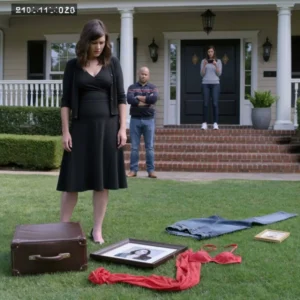
She stood on her front porch, arms crossed tightly across her chest. Her face looked pale, drawn in a way I hadn’t seen before.
Two officers stood in front of her.
The neighbors — people I’d known since I was a kid — formed a loose circle around the yard.
“She brings them here in the dark!” someone shouted from the sidewalk. “She’s stealing orphans!”
I pushed through the crowd, ignoring the looks and whispers, as I rushed to her side just as an officer held up a piece of paper.
“We have a warrant to search the house, ma’am.”
“Mom!”
My mom didn’t flinch but turned when she heard my voice.
“I came because—” I stopped, glancing at the surrounding people. “What’s going on?”
Everything seemed to go quiet for a second.
My mom didn’t argue. She just looked at the crowd gathered in her yard.
Then she said, calm and steady, “You’re all so very wrong.”
She stepped back and opened the door, gesturing for them to enter.
“Go ahead.”
I followed them inside. My hands were shaking.
I didn’t know what I was about to see. I guess I expected shadows and secrets.
We moved down the hallway, but as we turned the corner into the living room, I stopped dead in my tracks.
I was stunned by what I saw!
I didn’t see frightened children or anything hidden away.
I saw small beds, neatly arranged along the walls, each with folded blankets at the foot, as if from a modest shelter.
A whiteboard stood near the window with children’s photos and names written in marker — some crossed out, others freshly added.
There were backpacks lined up beneath it.
And then I noticed something else.
Every single item — every blanket and bag — had a tag on it.
I looked at my mom.
She just walked past me, calm and steady, as if she’d done this before.
The officers started checking the rooms, opening doors, and moving through the house.
I stayed where I was.
“Mom… what is this?” I asked.
She turned back to face me, and this time, she didn’t brush it off.
“This,” she said quietly, “is what they’ve been afraid of.”
“You will.”
When the officers returned to the living room, where some of the neighbors who’d followed us in were also standing, my mom walked over to the whiteboard.
One of the officers — tall, early 40s, with a badge reading “Daniels” — stepped closer.
“Ma’am, we’re going to need you to walk us through this.”
“Alright,” she said. “Then listen carefully.
Because every one of you got this wrong.”
I felt my body clench because what came next changed everything.
“I’m not bringing children here to keep them,” my mom explained. “And I’m not taking anyone from anywhere.”
A few people from outside had drifted into the doorway, trying to hear.
“I work with an emergency placement network. It’s legal and coordinated.
Social workers, church volunteers, and retired caregivers. People who step in when the system runs out of room or time.”
I frowned. “What does that mean?”
“It means,” she said, turning to me, “sometimes there are children who need a place immediately.
Not next week or after the paperwork. That night. So, they stay here.
One night. Maybe two. Until something more permanent is arranged.”
She gestured toward the beds.
Officer Daniels crossed his arms.
“And everything’s documented?”
“Yes. Every single child. Names, intake times, who brings them, and who picks them up.
Nothing happens without a record.”
I looked back at the whiteboard and the crossed-out names.
“They don’t stay long,” my mom added. “That’s the point. But when they arrive…” She paused, her voice softening.
“They need to feel like someone expected them.”
I looked at the backpacks again. The folded blankets. The tags.
I realized they weren’t random.
They were prepared and intentional.
“Some of the ‘sightings’ have just been starter kits, I gather, for the kids. Clothes that fit. A toy.
Basic things. Kids sometimes come in with nothing. I won’t have them walking into a room empty-handed.”
“And the night arrivals?” Officer Daniels asked.