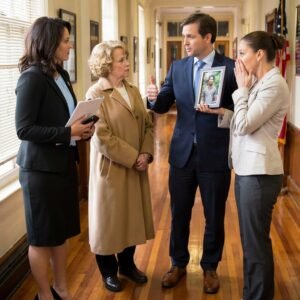
My mother Ives stood in my grandfather’s kitchen four days after his funeral and told me the cabin he built with his own hands in 1959 was going to my sister instead, because Wadsworth “has nothing, and you already have everything you need,” while my sister’s husband idled a moving truck in the gravel outside, the first boxes already loaded in the bed. The six acres of pine and creek bottom that went with that cabin, the whole life my grandfather had built out there, my mother handed over in the space of one sentence, in a kitchen that was not hers to hand anything out of anymore.
I am fifty two years old. I have three grown children, a husband named Jarrow who has never once in twenty nine years of marriage raised his voice at me, and a job doing the books for the Millbrook Flats Feed and Seed that I have held since I was twenty six. By any measure my mother would use in public, I am the daughter who turned out fine. I own a house. I have never asked her for money. I show up. And it was the showing up, more than anything else, that made that moment in my grandfather’s kitchen the strangest of my life, because I was standing in a cabin I had spent every Saturday of the last two years keeping alive, being told by the woman who had not driven out to see her own father in longer than she would admit, that I did not need what he had left me.
Except he hadn’t left it to me the way she thought. She was talking about intentions, about what she assumed was still sitting in a will somewhere waiting to be divided up fair, or unfair, depending on which daughter you asked. She did not know, because my grandfather had asked me not to tell her while he was alive, that the cabin was not his to give away anymore, and had not been for two years. It was already mine. Recorded, notarized, filed at the Piney County Courthouse under my name, Harlow, in black ink that did not care one bit what my mother thought was fair.
I did not say that in the kitchen. I want to be honest about that from the start, because it would be a better story if I had, if I had pulled the paper out of my purse right then and set it on the counter next to her coffee cup and watched her face change. But I did not have the paper with me. I had grief, and I had twenty nine years of practice not fighting my mother in front of witnesses, and so I did what I have always done. I said I needed some air, and I walked down to the creek, and I let the water do what it has always done for the Stroud family, which is carry off whatever a person cannot carry on their own for a while.
The cabin on Sugar Camp Creek
My grandfather was Delafield Stroud, and before he was anyone’s grandfather he was a nineteen year old Army sergeant from a dirt farm outside Millbrook Flats who spent thirteen months in Korea and came home in the winter of 1954 not talking about most of it, ever, to anyone, except once a year at the VFW Post breakfast on the second Saturday of November, where the men who had been there with him would talk in the particular shorthand of people who do not need the whole sentence to understand each other.
He came home with a little money saved from his Army pay and a conviction that had nothing to do with real estate and everything to do with survival, which was that a man ought to be able to point at something solid and say I built that, with my hands, and it will still be standing after I am not. He bought six acres along Sugar Camp Creek two miles outside town for eleven hundred dollars, land nobody else wanted because it flooded some springs and the ground was too rocky for row crops, and he spent the better part of two years, working around shifts at the sawmill, cutting and notching and stacking logs until he had a two room cabin with a stone chimney he built himself out of creek rock, one stone at a time, hauling them up from the water in a wheelbarrow with a bad wheel that squeaked the whole way.
He married my grandmother the year he finished it. They raised my mother and my aunt Denmark, who died young, of a fever, before I was ever born, in that cabin and in the house they later built in town, but the cabin never stopped being the center of things. Every Easter, my grandfather hid eggs in the roots along the creek bank and told us the ones we never found were now officially the property of the crawdads. Every Fourth of July, there were more people crammed onto that little porch than the porch was built to hold, and nobody minded. He added a screened sleeping porch in the seventies for the grandkids, built a fire ring down by the water, and every single year, on the second Saturday of November after the VFW breakfast, he drove out to the cabin alone for an hour before anybody else arrived, and nobody ever asked him what he did out there, because some things in a family you simply let a person keep.
That was the cabin my mother stood in and called something Wadsworth needed more than I did.
Ives and Wadsworth
I want to be fair to my mother, because there is a version of this story where she is simply a villain, and that is not the whole truth, even if it is the part that stings the most. My mother loves her daughters. She has just never loved us the same amount, and she has never once, in fifty two years, been able to see that about herself.
Wadsworth is three years younger than I am, and from the time we were girls, there was a pattern to us that never changed no matter how many times I told myself it would. I was the one who got good grades because grades were the only currency I understood how to earn attention with. Wadsworth got the attention anyway, because Wadsworth was easier to worry about, and my mother has always confused worry with love, has always given her fullest self to whichever daughter seemed to be drowning that particular year.
Wadsworth married young, to a man named Oglesby who sold farm equipment two counties over and had a habit of chasing deals that never quite paid off the way he promised. There was the trucking venture. The rental properties in Fort Smith that turned out to have a lien on them nobody checked for. The feed store franchise that closed within fourteen months. Every time, my mother stepped in, not always with money she had, sometimes with money she borrowed against her own house, and every time she explained it to me the same way, in the same patient voice, as if I were the one who needed convincing.
“Wadsworth doesn’t have your head for this, Harlow,” she would say. “You’ve always landed on your feet. Some people just need more help landing.”
I used to think if I just kept landing on my feet loudly enough, kept being visibly fine, she would eventually notice that being fine took work too, that Jarrow and I built what we had one grocery budget at a time, that I was not born standing upright, I had simply stopped falling down in front of her by the time I was twenty five so she never had to watch it happen. I stopped waiting for that particular recognition around the time I turned forty. It was not a sad realization by then. It was just a fact I had made peace with, the way you make peace with a crooked fence post that has held the line fine for years even though it never got fixed properly.
The last two years
My grandfather started slowing down the winter he turned eighty seven. Nothing dramatic. His knees went first, then his hearing, then a spell of pneumonia that put him in the Millbrook Flats clinic for four days and scared all of us more than we admitted to each other. After that, I started driving out to the cabin every Saturday, sometimes twice a week if the weather turned, to split kindling for his stove, to sit with him while he ate the soup I brought, to drive him to Lockridge’s Diner on the county road for the chicken fried steak special he was not supposed to have and ordered anyway, every time, daring me to say something.
Jarrow came most Saturdays too. He is a quiet man, my husband, the kind who shows love through fixing things rather than saying things, and he rebuilt the porch steps that winter without being asked, replaced two rotted logs near the chimney, ran a new line out to the well pump when the old one finally gave out. My grandfather used to sit in his chair and watch Jarrow work and say, “That man of yours doesn’t waste words, does he,” and I would tell him that was exactly why I married him, because I grew up in a house where words got thrown around loud and cheap, and I wanted a life built out of the other kind.
Wadsworth visited twice in those two years. Once at Christmas, for about ninety minutes, and once in the spring when she needed to ask my grandfather, gently, delicately, whether he might be willing to cosign a small business loan for Oglesby’s latest venture, a mobile detailing service that never got past the paperwork stage. My grandfather said no. It was, as far as I know, the only time in his life he ever told Wadsworth no to her face, and he told me about it afterward sitting on the porch with a look on his face I had never seen before, something between guilt and relief.
“I love that girl,” he said. “I have loved her since the day she was born. But I am eighty eight years old, Harlow, and I have started noticing who actually drives out here.”
I did not say anything. I just handed him another cup of coffee and let the creek make its noise below us, and we sat there a long time not talking, the way people do when a thing has been said that does not need anything added to it.
The deed
It was the following month, on a gray Tuesday in March, that my grandfather asked me to drive him into town instead of the diner. He would not tell me where until we pulled up outside the office of Ballard Ridgely, a lawyer on the courthouse square who had served with him in the same unit in Korea and had been drawing up wills and deeds for half the families in Piney County for forty years.
“I want this place to go to somebody who will keep the roof from caving in,” my grandfather told me, sitting in Ballard’s little office with the ceiling fan ticking overhead. “Not somebody who will sell it the week after the funeral because it’s easier than fighting over it. I have watched you out there for two years, Harlow. You are the one who kept the fire going in that stove all winter. This cabin is yours.”
I told him he did not have to decide that right now, that we had time, that I did not want him thinking about wills at eighty eight over a chicken fried steak he was not even getting that day. He waved that off the way he waved off most things he had already made his mind up about.
“Your mother is going to want to hand it to your sister the day I’m in the ground,” he said, not unkindly, just plainly, the way he said most things. “She has spent thirty years trying to even out a scale that was never actually unbalanced, it was just two different girls carrying two different weights. I am not going to argue with her about it from a casket. So we are going to fix it now, while I can still hold a pen.”
Ballard drew up the deed that same week. A warranty deed, six acres and the cabin on it, transferred from Delafield Stroud to me, recorded at the Piney County Courthouse on the fourteenth of March, two years before he died, notarized, stamped, filed in the public record where anyone with a reason to look could go find it. My grandfather handed me a certified copy in a plain envelope on the porch that Saturday and told me exactly one thing.
“Don’t wave this around while I’m alive,” he said. “Let your mother believe whatever she wants to believe until I’m gone. I don’t have the years left to spend them refereeing. But you keep that paper somewhere safe, and if the day ever comes that somebody tries to tell you different, you let the paper do the talking. It will do a better job of it than either one of us could.”
I put the envelope in the fireproof box in our bedroom closet, behind Jarrow’s discharge papers and the deed to our own house, and I did not think about it again until the day it mattered.
The funeral
My grandfather died in his sleep on a Sunday in late September, two years almost to the week after that afternoon in Ballard’s office. He had gone to the VFW breakfast the day before, eaten two helpings of biscuits and gravy, and told the men at his table a joke about a mule that Jarrow still repeats at Thanksgiving. Whatever a person could ask for in the way of an ending, he got about as close to it as this life allows.
We buried him with military honors at the Millbrook Flats cemetery, a folded flag, a bugler from two counties over because Piney County did not have one of its own anymore, and a rifle volley that made half the church flinch and the other half stand up straighter, the way it always does with that generation. First Baptist put on the funeral dinner after, the whole fellowship hall lined with casserole dishes and sheet cakes brought by women who had known my grandfather sixty years, and Wadsworth cried harder than anyone in the building, which I want to say plainly here, because I think it matters: her grief was real. Whatever else is true about my sister, she loved our grandfather, in her own scattered, occasional way, and losing him hurt her.
My mother did not cry much that day. She has never been a crier in public. She stood at the graveside with her hands folded and her jaw set, and it was not until we were back at the cabin four days later, going through his things, that I understood she had spent that entire week not grieving so much as deciding.
Four days later
She called it a family meeting, though it was really just the two of us and, apparently, Oglesby’s truck already backed up the gravel drive with the tailgate down. I remember the sound before I understood what it meant, the low idle of an engine that should not have had any reason to be there yet.
We stood in my grandfather’s kitchen, the same kitchen where he had made me coffee a hundred Saturdays running, and my mother told me, in the calm and reasonable voice she uses when she has already rehearsed a conversation in the car on the way over, that she had decided the cabin should go to Wadsworth.
“She has nothing, Harlow,” my mother said. “You already have everything you need. A good marriage, a paid off house, a job you’ve held twenty six years. Wadsworth needs a place to land, and this is it. I know it’s not what your grandfather would have written down on paper if he’d ever gotten around to it, but you understand, don’t you. You’ve always understood things like this.”
I asked her what she meant by “if he’d ever gotten around to it,” and she said, without a flicker of doubt, that as far as she knew he had died without a will covering the cabin specifically, which meant it fell to her and Wadsworth and me to sort out fairly, and she had already sorted it. Oglesby, she said, was just bringing over the first load of boxes so they could get ahead of the cold weather before the roads turned bad.
I looked out the window at that idling truck, at Oglesby leaning against the tailgate scrolling his phone like a man waiting on a delivery he had already been promised, and something in me that had been quiet for twenty nine years sat up very straight.
“You should ask before you load a truck, Mama,” I said. It was the only thing I let myself say. Then I told her I needed some air, and I walked down to the creek, the way I have walked down to that creek my whole life when a thing got too big to hold still for.
The recorder’s office
I did not go back to the cabin that day. I went home, and I told Jarrow everything standing in our own kitchen with my coat still on, and he listened the way he always listens, without interrupting, and when I finished he asked me one question.
“You still have the envelope?”
We drove to the Piney County Courthouse first thing Monday morning. The clerk at the recorder’s window was a woman named Fairweather who had gone to Millbrook Flats High two years behind me, and when I told her what I needed, a certified copy of the recorded deed, book and page number and all, she pulled it up on the computer inside four minutes and printed it with the county seal stamped fresh across the corner.
“Recorded March fourteenth, two years back,” she said, reading it over before she handed it across the counter. “Clean as anything I’ve seen. Grantor Delafield Stroud, grantee Harlow Stroud. Whole six acres, cabin included, described right down to the creek bank.” She looked up at me. “Somebody trying to tell you different?”
“Somebody’s trying,” I said.
“Well,” Fairweather said, sliding the paper across, “the county doesn’t much care what anybody’s trying. The county cares what’s recorded.”
I called Ballard that same afternoon, more out of respect than necessity, because I wanted him to hear it from me before he heard it from anyone else that the paper he had drawn up two years ago was about to get used for exactly the purpose my grandfather intended. He was quiet on the line for a second, and then he said, “Delafield knew this day was coming, Harlow. He told me so, sitting in that same chair you sat in. He said, and this is close to word for word, ‘My daughter Ives has spent her whole life trying to make things even between those two girls, and she has never once managed it, because life was never asking her to make it even. It was asking her to see them.’ He wanted you protected from having to fight for something that was already settled. I’m glad you’re not going to have to.”
Moving day
The following Saturday, I drove back out to Sugar Camp Creek with Jarrow beside me and the certified copy of the deed in a manila envelope on the seat between us. The truck was there again, fuller this time, half of Wadsworth’s living room furniture strapped down under a blue tarp in the bed, and my mother was standing on the porch directing Oglesby where to set a dresser like she had directed every rearrangement of furniture in this family for thirty years.
Wadsworth was there too, in the doorway of the cabin, my grandfather’s cabin, holding a box of dish towels, and when she saw me get out of the truck her face did something complicated, something between guilt and relief that I recognized because I had seen it once before, on our grandfather’s face, in Ballard’s office.
I did not raise my voice. I want that understood, because I know how this kind of story usually gets told, with the wronged daughter finally exploding, finally saying everything she has swallowed for thirty years. That is not what happened, and I think my grandfather would have been prouder of me for it not happening that way.
I walked up onto the porch, and I said, “Mama, before Oglesby carries one more thing through that door, I need you to look at something.”
I handed her the envelope. She opened it slowly, the way you open something you already suspect you are not going to like, and I watched her eyes move down the page, watched her find the date, March fourteenth, two years back, watched her find my grandfather’s signature and Ballard’s notary seal and the county’s recording stamp pressed into the corner of the paper like a period at the end of a sentence that had already been written.
“This isn’t possible,” she said. “He never said a word to me about this.”
“He wasn’t required to,” I said. “It’s a recorded deed, Mama, not a family vote. He deeded it to me two years ago, while he was alive and of sound mind, with a lawyer he’d known fifty years standing right there watching him sign it. It has been mine since the spring before last. I have known that whole time, and I did not tell you, because he asked me not to, because he did not want to spend whatever time he had left refereeing between you and me about a piece of paper. He wanted his last two years, and he got them, quiet.”
The paper
My mother’s face went through several things in a row, standing there on that porch with the paper trembling slightly in her hand, and I let her go through all of them without interrupting, because I think a person is owed the space to be wrong in front of you without an audience rushing them along.
“You let me believe,” she started, and could not finish the sentence, because she was not entirely sure what she wanted to accuse me of. Tricking him. Manipulating an old man. Neither one was true, and some part of her seemed to know it even as she reached for it.
“I let you believe whatever you already believed,” I said. “I never told you a single thing that wasn’t true. I told you I needed some air last Tuesday. That was true. I have been true with you my whole life, Mama. I have just also, for once, kept something for myself instead of handing it over so somebody else could feel less like they were drowning.”
Wadsworth set the box of dish towels down on the porch rail. She had not said a word yet, and when she finally did, her voice was smaller than I had heard it since we were girls.
“I didn’t know either,” she said. “Harlow, I promise, I did not know. Mama told me it was settled, that you’d already agreed, that you had your own house and didn’t want the upkeep out here.” She looked at our mother, and something passed between them that I had never once seen before, my sister looking at our mother with something other than gratitude. “You told me she’d agreed to it.”
My mother did not answer that. She looked back down at the paper instead, at the recording stamp, at the county seal, at the plain unbending fact of it, and for the first time in longer than I could remember, I watched my mother run entirely out of a rehearsed thing to say.
Oglesby set the dresser down in the driveway and did not carry it any further. Nobody told him to stop. He just understood, the way people understand weather changing, that the day had turned into a different day than the one he had loaded a truck for that morning.
Grace
I could have made her stand there longer. I could have let the silence do more work on her than it already was doing. I did not, because somewhere between the creek and that porch I had decided, without fully realizing I was deciding it, what kind of daughter I wanted to be at the end of this, and it was not the kind who wins by making someone else lose in front of an audience.
“I’m not asking you to leave the property today, Oglesby,” I said. “Set the dresser back on the truck when you’re ready, no rush. I’m not angry at you, or at Wadsworth. This isn’t about punishing anybody.” I turned to my mother. “It’s about the fact that this cabin was his to give, and he gave it to me, and that is simply what happened, whether it fits the story you’ve been telling yourself for thirty years or not.”
I told them both what Ballard had told me on the phone, my grandfather’s words as close to exact as I could carry them, that our mother had spent her whole life trying to make things even between two daughters life had never asked her to make even, only to see clearly. I watched that land on my mother in a way the deed itself had not quite managed to. Paper can prove a fact. It cannot always make a person feel it. But hearing her own father’s assessment of her, secondhand, through a stranger’s memory of an office visit two years back, seemed to reach some part of her the recording stamp could not.
She did not apologize that day. I want to be honest about that too, because a tidy story would have her weeping on the porch asking forgiveness, and my mother has never once in fifty two years done anything of the kind, and I was not expecting Sugar Camp Creek to be the place she started. What she did instead was quieter, and in its own way, harder for her. She sat down on the porch step, the same step Jarrow had rebuilt two winters before, and she said, “I don’t know how to stop doing this. Choosing. I have been choosing between the two of you since you were small enough to carry, and I don’t know anymore if I ever knew how to do anything else.”
“You could start by not choosing,” I said. “You could just let us both be your daughters, the same amount, out loud, where we can hear it.”
After
That was ten months ago. The cabin is mine on paper the way it was always meant to be, and I have spent the months since fixing what two years of my grandfather’s failing hands could not keep up with on their own, a new coat of stain on the logs, a rebuilt section of chimney where the mortar had started to crumble, a dock Jarrow and our son in law put in down at the creek bend where the water runs slow enough for the grandkids to wade.
I did not lock my family out of it. That was never the point, and I think if it had been, my grandfather would have found some way to be disappointed in me from wherever he has ended up. This past Fourth of July, the porch held more people than it was built to hold, same as always, and Wadsworth was one of them, sitting in a folding chair with her youngest on her lap, and when I brought out a plate of deviled eggs she caught my eye and said, quiet enough that only I heard it, “Thank you for not making me feel like I had to choose sides that day.” I told her there had never been sides, only a truth that took a minute to catch up with all of us.
My mother came too, and stood by the fire ring a while, not saying much, watching the grandkids chase each other down toward the water the way three generations of this family have chased each other down toward that same water. She has not become a different person. I do not expect her to, at seventy four, after a lifetime of practicing the same habit of the heart. But she calls me now on Tuesdays, just to talk, which she never used to do, and last month she asked if she could bring a casserole out to the cabin for no occasion at all, and I said yes, and she came, and we sat on the porch and ate it together while the creek made its noise below us, and neither one of us mentioned the deed at all, because for the first time in a long while, we did not need to.
I think about my grandfather most on the second Saturday of November now, the way he used to drive out here alone for an hour before the rest of us arrived. I do the same thing these days. I sit on the porch he built with his own hands out of logs he cut and notched himself, in the quiet, before anybody else pulls up the drive, and I think about a nineteen year old sergeant coming home from a war he never talked about, deciding the one thing he wanted in this life was something solid he could point to and say, that will still be standing after I am not. It is still standing. It is mine, the way he meant it to be, and it will be my daughter’s after me, because some inheritances are not really about property at all. They are about somebody, somewhere down the line, finally being seen clearly for exactly who they showed up to be.
This story is a dramatization. Names, characters, and details are invented, and any resemblance to real people or events is coincidental.